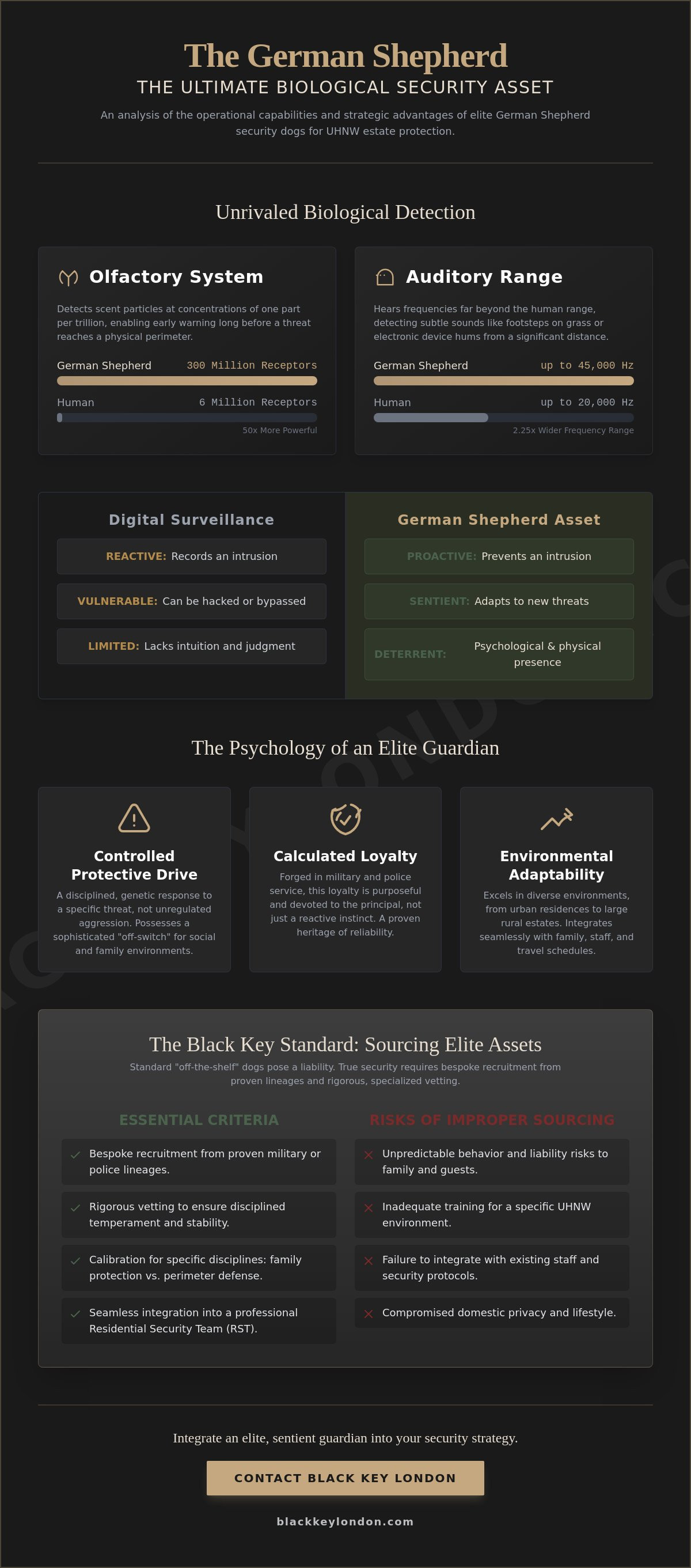
The most sophisticated digital surveillance system is reactive; it records an intrusion rather than preventing it. Data from the 2022 Crime Survey for England and Wales suggests that visible physical deterrents remain the primary factor in preventing domestic breaches. For the principal who requires absolute peace of mind, german shepherd security dogs represent a proactive, biological solution that no technology can replicate. You likely value your home as a private sanctuary, yet you may worry that an elite protection asset could pose a liability to your family or guests.
It's a common concern that the line between a loyal companion and a tactical guardian is difficult to define. This article demonstrates why the German Shepherd is the definitive choice for sophisticated estate protection and how to integrate these elite sensors into a professional strategy. We'll examine the operational methodology for sourcing Tier-1 animals and the rigorous vetting required to ensure they're a seamless fit for your lifestyle. You'll discover how to achieve an integrated security environment that is both discreet and uncompromising, allowing you to live without concern.
Key Takeaways
- Understand why the German Shepherd is regarded as the ultimate biological sensor, providing sensory detection capabilities that surpass even the most advanced technical surveillance.
- Learn the vital distinction between executive protection and perimeter defense to ensure your asset is calibrated for your specific environment and lifestyle.
- Discover the strategic logistics required to integrate german shepherd security dogs into a professional Residential Security Team (RST) without compromising domestic privacy.
- Recognize the risks of "off-the-shelf" procurement and why bespoke recruitment from proven military or police lineages is essential for UHNW estates.
- Gain insight into the rigorous vetting process that ensures your security asset remains a disciplined guardian and a seamless addition to your private estate.
Why the German Shepherd Remains the Gold Standard for Personal Protection
The German Shepherd is not merely a pet; it is a sophisticated biological security system. For the modern principal, german shepherd security dogs represent the pinnacle of canine engineering. This breed is defined by a singular combination of high-intelligence, physical prowess, and an unparalleled work ethic. When we look at the German Shepherd breed standard, we see a dog designed for utility, endurance, and mental clarity. It is this foundation that allows them to transition from a calm presence in a boardroom to an active deterrent in seconds.
Historically, the breed's reputation was forged in the demanding theaters of military and police service. From the trenches of the 20th century to modern special operations units, their reliability is documented and proven. This heritage of service provides a "Loyalty-to-Utility" ratio that is unique. While other breeds may offer raw power or high energy, the German Shepherd offers a calculated, disciplined loyalty. They do not just protect out of instinct; they protect out of a trained, purposeful devotion to the principal.
In 2026, UHNWIs are increasingly prioritizing these dogs for estate defense. Technology alone is no longer enough. Cyber-security and physical barriers have their limits, but a sentient guardian provides a proactive layer of defense that cannot be hacked or bypassed. They offer a physical presence that commands respect while maintaining the absolute discretion required for a private lifestyle. At Black Key London, we recognize that the elite guardian must be as refined as the environment they protect.
The Psychology of the Guardian
The true value of german shepherd security dogs lies in their cognitive ability to differentiate between a welcome guest and a legitimate threat. This requires a sophisticated "off-switch" that allows the dog to relax during family dinners or social events. Protective drive is a controlled, genetically rooted response to a specific threat, whereas aggressive drive is an unregulated, reactive temperament that has no place in a private residence. Our selection process focuses on dogs that possess the former, ensuring they remain composed under pressure.
Versatility Across Environments
A premier protection dog must be as adaptable as the principal's schedule. Whether navigating the tight corridors of a London townhouse or patrolling the perimeter of a 500-acre rural estate, the German Shepherd excels. Their ability to travel seamlessly via private jet or vehicle ensures that protection is never interrupted. They are trained to integrate into complex households, working harmoniously with existing staff and showing gentleness toward family pets. This adaptability makes them the invisible but essential support structure for global life.
The Operational Capabilities of a Trained Security Asset
A German Shepherd isn't a pet; it's a sophisticated biological sensor. While high-definition thermal cameras and vibration sensors provide essential data, they lack the intuition of a living asset. The german shepherd security dogs we source represent a force multiplier for any close protection detail. They bridge the gap between passive technology and active human intervention. Intelligence. Power. Reliability.
Their physical metrics are formidable. A mature male can reach speeds of 30 miles per hour and possesses a bite force measured at approximately 238 PSI. These traits align with the official breed standards which emphasize structural integrity and agility. Beyond raw power, the deterrence factor is psychological. A potential intruder might attempt to bypass a laser tripwire; they'll rarely risk an encounter with a 40kg guardian. This presence alone often concludes a security event before it escalates.
Biological Detection and Early Warning
Detection begins long before a perimeter breach occurs. A German Shepherd's olfactory system contains up to 300 million receptors, compared to a human's 6 million. They identify scent particles at concentrations of one part per trillion. In a practical sense, this means the dog detects an intruder's presence 200 meters away, well before they enter the range of standard motion sensors. They hear frequencies up to 45,000 Hz, capturing the faint click of a gate or the rustle of clothing that microphones might miss.
Early warning is delivered through non-verbal cues. A subtle change in posture or a low, directional alert allows a security team to initiate counter surveillance protocols without alerting the target. This silent communication maintains the element of surprise. It ensures the principal remains undisturbed while the threat is neutralized. Discretion is as vital as detection.
Controlled Intervention
Reliability is the hallmark of an elite asset. Training focuses on the "hold and bark" method. This ensures the dog contains a threat without escalating to a strike unless absolutely necessary. Under high-stress scenarios, voice command reliability is non-negotiable. The dog must cease engagement instantly upon the handler's word. This level of control is what separates a professional security dog from an aggressive animal.
Protection is a defensive operational mode. It isn't about aggression; it's about control. These animals are trained to identify specific hostile behaviors while remaining social and calm in the presence of family and guests. This level of discipline requires years of specialized work. If you require this level of integrated safety, you may wish to discuss your estate's specific requirements with our team.
Family Protection vs. Perimeter Defense: Choosing the Right Discipline
Selecting german shepherd security dogs for a private estate requires a clear distinction between a "manned guarding" asset and an "Executive Protection" companion. A manned guarding dog is often a tool for perimeter denial; it's a high-drive animal kept in a kennel and handled only by professionals. For the UHNW principal, this is rarely the ideal solution. You require a dog that functions as a seamless extension of your household. This is the Executive Protection dog. It's a social asset, capable of transitioning from a quiet evening in the library to active defense in seconds.
The hierarchy of training is rigid. It begins with absolute obedience. Protection work only follows once a dog is 100% stable in varied environments. We prioritize environmental socialization because a dog that's spooked by a vacuum cleaner or a delivery driver is a liability. It's vital to avoid "police rejects" or animals bred solely for aggression. While these dogs possess the raw traits for police and security work, they often lack the "off switch" necessary for domestic life. A dog trained only to bite is a weapon you can't control; a dog trained to protect is a partner you can trust.
The Myth of the "Scary" Guard Dog
Fear isn't a security strategy. A dog that snarls at every passerby isn't "protective"; it's insecure. This behavior often stems from fear-based training, which creates an unpredictable liability. Top-tier german shepherd security dogs possess a quiet, calm confidence. They don't need to bark to prove their presence. You can identify an over-trained dog by its inability to settle. If the animal is constantly "on the muscle" or hyper-vigilant in a safe environment, it hasn't been calibrated for the nuances of a private estate.
Temperament Testing for HNW Environments
Discretion is paramount. Your security dog must be safe around children, guests, and household staff. We look for stable European bloodlines, specifically those adhering to rigorous SV standards in Germany or Czech working lines. These lineages are vetted for clear-headedness under pressure. For a deeper analysis of how these animals compare to other breeds, consult our guide on the best security dogs for elite guardians. We ensure every dog undergoes rigorous testing to guarantee they're as comfortable in a boardroom as they are on a 50-acre perimeter patrol.
Strategic Integration: Managing a Canine Asset within an UHNW Estate
Integrating german shepherd security dogs into a private estate requires more than a kennel and a fence. It demands a tactical marriage of biology and technology. This is an asset that lives and breathes; its effectiveness depends entirely on the structure surrounding it. Within a High-Net-Worth environment, the dog must remain invisible until the moment it's required. It's not a pet. It's a biological sensor with a 225-million-scent-receptor capability. Service. Discretion. Protection. These values guide the integration process to ensure the canine becomes a seamless extension of the existing security architecture.
The Handler-Protector Relationship
The bond is the bypass. Without a clear hierarchy, the security layer fails. We insist the principal joins the final 48 hours of the transition phase at the training facility. This ensures the dog recognizes the family as the core "pack" to be protected, not a variable to be monitored. The transition from the facility to the estate typically takes 14 to 21 days. During this window, we establish the "one relationship" protocol. This limits primary commands to a single handler or the principal. It prevents command confusion. It maintains absolute authority. Ongoing maintenance requires 60 minutes of high-intensity exercise and 15 minutes of scent-work daily to keep the asset sharp. Training isn't a one-time event; it's a 90-day cycle of refinement.
Operational Protocols for Residential Security
German shepherd security dogs function best when synchronized with a personal bodyguard and existing tech stacks. They provide the "audible" layer that CCTV lacks. On a standard 10-acre estate, we implement a strict rotation of "free-run" and "kennel" times. This prevents the dog from becoming desensitized to its environment. When the dog is on duty, its alerts are integrated into the Global Security Operations Center. A dog’s reaction to a perimeter breach often occurs 3 to 5 seconds before a motion sensor triggers an alarm. This window is the difference between a proactive response and a reactive one.
- Social Management: During events with more than 10 guests, the dog is moved to a secure, climate-controlled facility or handled exclusively by a professional to avoid overstimulation.
- Travel Logistics: For principals moving between international residences, we coordinate "canine passports" and private aviation charters. The dog doesn't fly in a cargo hold; it remains with the team.
- Maintenance: Quarterly assessments by a former military or police dog instructor ensure the asset hasn't developed "soft" habits in the domestic setting.
Managing an elite guardian is about discipline and routine. It's a commitment to a higher standard of safety. One trusted individual. One relationship. Total peace of mind.
The Black Key Standard: Sourcing Elite Protection
Procuring a high-tier security asset requires more than a simple transaction; it demands a strategic alignment. For the UHNWI, an off-the-shelf purchase is a liability. We don't just source. We recruit. At Black Key London, we treat the selection of german shepherd security dogs with the same rigor applied to close protection officers. Our methodology is rooted in decades of frontline experience within the Royal Marines and specialist police units. We understand that a dog is not a piece of equipment. It's a living extension of your security detail. One trusted individual. One relationship. Excellence through discipline.
Black Key London bridges the gap between specialized canine providers and the complex demands of a high-net-worth lifestyle. We act as the technical authority, ensuring that the animal's temperament and training are perfectly calibrated to the Principal's environment. We are not a security company. We are elite lifestyle managers who prioritize your peace of mind above all else. Our role is to filter out the noise, presenting only the most exceptional candidates that meet our "Battle-Hardened" criteria. We ensure the transition is seamless, professional, and entirely private.
Discretion and Vetting
Privacy is our baseline. When sourcing a high-profile security asset, the vetting process must be absolute. We conduct a 48-point evaluation of every training facility before they earn our recommendation. This includes a deep dive into their operational history and ethical standards. Our "Invisible Security" philosophy dictates that german shepherd security dogs should provide protection that doesn't disrupt the home. The goal is a seamless integration. Your estate remains a sanctuary, not a tactical outpost. We look for the quiet gravity of expertise in every animal we place.
Next Steps for the Principal
The journey to integrated protection begins with a 360-degree security risk assessment of your private estate. We identify physical vulnerabilities and lifestyle patterns to determine the exact requirements for your canine guardian. Deployment is a methodical process. From the initial confidential briefing to the final handover at your property, the timeline typically spans 12 weeks. This period allows for bespoke training tailored to your specific acreage and family dynamics. It ensures the bond between the Principal and the dog is forged in trust.
Begin your consultation. We invite you to a confidential briefing to discuss the unique requirements of your estate. Our experts are ready to translate military-grade reliability into a refined, premium service for your home. Service. Discretion. Protection. The people behind the principal are ready to assist.
Defining the Standard of Private Protection
Securing a global estate requires more than passive technology; it demands a living, breathing deterrent with the intelligence to discern and the power to act. german shepherd security dogs represent the gold standard of this capability, offering a unique blend of family loyalty and tactical perimeter defense. These assets don't just react to threats. They provide a proactive layer of safety that technology alone cannot replicate. Integrating such a sophisticated asset into an UHNW environment requires a level of precision that generalist agencies simply don't possess.
Black Key London was founded by former Royal Marines and specialist police officers to translate elite operational experience into a refined, premium service. We specialize in bespoke recruitment, ensuring every placement meets the rigorous standards of the UK's most elite units. Absolute discretion is our baseline. We understand that for our principals, privacy is as vital as physical safety. We provide the silent, professional support structure that allows you to move through the world with total confidence.
Secure your estate with an elite canine guardian. Contact us for a confidential consultation.
Frequently Asked Questions
Are German Shepherd security dogs safe to have around young children?
German shepherd security dogs are safe around children when they're sourced from bloodlines bred for environmental stability. These dogs distinguish between a physical threat and family play. In a 2023 study of working breeds, the German Shepherd ranked in the top 10 percent for temperament and adaptability. They integrate into the household as a calm, watchful presence. Discipline is the foundation. A well-bred dog understands the hierarchy of your home.
What is the difference between a guard dog and a personal protection dog?
A guard dog is trained to secure a perimeter, while a personal protection dog is trained to defend the principal and their family. Guard dogs often work independently in fenced areas. Personal protection dogs are socialized to accompany you in public spaces. They remain under your control at all times. This distinction is critical for estate management. It's the difference between a simple fence and a dedicated bodyguard.
How much does a fully trained German Shepherd protection dog cost in 2026?
According to the 2024 International Protection Canine Association report, a fully trained German Shepherd in 2026 will command between 45,000 and 120,000 dollars. These figures reflect the 2,000 hours of specialized instruction required for elite performance. Costs include extensive health clearances, advanced bite work, and environmental conditioning. You're investing in a living asset. The price reflects the years of expert labor invested before the dog arrives.
Does a security dog need a professional handler at all times?
You don't need a professional handler if you undergo the mandatory handover training provided by the specialist trainer. Most elite programs include a 14 day integration period for the principal. This ensures you can command the dog effectively in high-stress scenarios. The dog is a tool for your protection. Once the bond is established, the dog operates as a seamless extension of your personal security detail.
Can I take my German Shepherd protection dog with me when I travel abroad?
You can travel internationally with your dog provided you adhere to the specific health and import regulations of the destination country. Most European Union nations require an EU Pet Passport and a rabies vaccination administered at least 21 days before travel. Private aviation makes this process significantly easier for the principal. We recommend a dedicated travel crate that meets IATA standards. Protection remains constant across all jurisdictions.
How long does it take to train a German Shepherd for elite estate security?
It takes approximately 18 to 24 months to train german shepherd security dogs for elite estate security. This timeline begins with foundational obedience and moves into complex protection scenarios. By the age of two, the dog has completed over 500 individual training sessions. This rigorous schedule ensures the animal can handle the pressures of a busy private estate. Precision takes time. There are no shortcuts to excellence.
Is it better to buy a puppy or a fully trained adult German Shepherd?
Buying a fully trained adult is the preferred choice for immediate security needs. An adult dog has a proven temperament and a completed health record, including hip and elbow certifications. Puppies are a 24 month gamble on genetics and drive. With an adult, the capability is already forged. You're purchasing a finished product ready for operational service on day one. It removes the uncertainty of development.
What happens if my security dog bites a guest or a delivery person?
An elite security dog will not bite a guest or delivery person unless given a specific command or if a clear, violent threat is detected. They're trained to remain in a passive alert state during social interactions. Proper socialization ensures the dog recognizes the difference between a courier and an intruder. Liability is managed through rigorous training and clear handler protocols. Control is the hallmark of a professional guardian.