
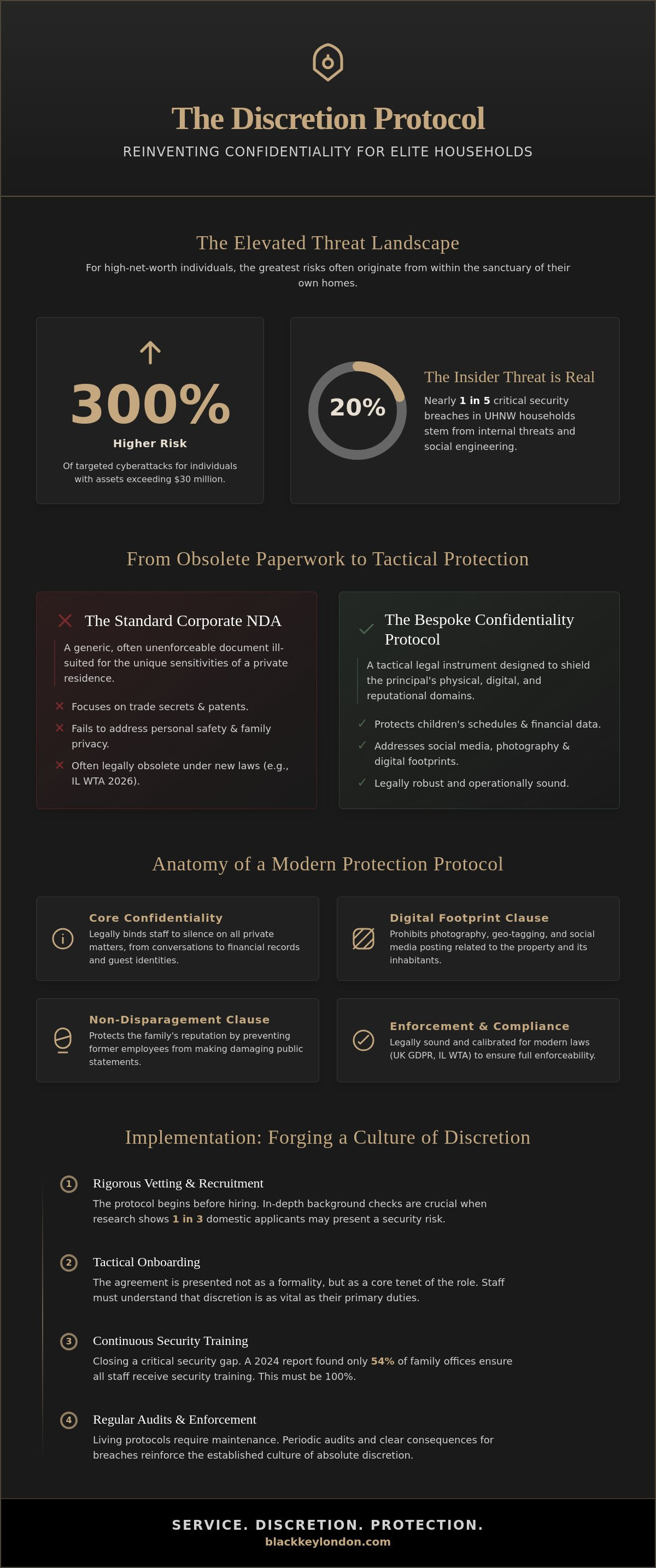
For individuals with assets exceeding $30 million, the risk of a targeted cyberattack is 300% higher than the general population. It's a sobering reality. Often, the breach doesn't come from a remote hacker but from the very people you've invited into your home. Internal threats and social engineering now account for nearly 20% of critical security breaches in high-net-worth households. This is why confidentiality agreements for household employees are no longer just legal formalities. They are tactical operational layers designed to protect your digital and physical footprint from the inside out.
You understand that true privacy is a requirement for your family's safety. It's about the people behind the principal. However, with the January 1, 2026, amendments to the Illinois Workplace Transparency Act, many existing agreements are likely obsolete or legally unenforceable. We'll show you how to build a robust legal framework that meets these new standards while ensuring your staff maintains total discretion. You'll learn to transform a standard contract into a comprehensive security protocol that offers genuine peace of mind. One trusted individual. One relationship. Absolute protection.
Key Takeaways
- Discover why standard corporate NDAs fail in a domestic setting and how to build a tactical barrier that protects your physical safety.
- Identify the essential clauses for confidentiality agreements for household employees that specifically address social media, photography, and digital footprints.
- Establish a culture of discretion through operational protocols, moving from static paperwork to active onboarding and regular privacy audits.
- Learn how an integrated approach to recruitment and vetting ensures that the people behind the principal are as secure as the residence itself.
Defining the Protocol: What are Confidentiality Agreements for Household Staff?
Privacy isn't a luxury. It's the foundation of security. For a principal, the boundary between public life and private sanctuary must be absolute. A domestic confidentiality agreement is a bespoke legal instrument designed to protect that boundary. It's a formal recognition that every individual entering your home is a witness to your life. While a foundational Non-Disclosure Agreement (NDA) might suffice for a mid-level corporate hire, it's often insufficient for the domestic sphere. Standard corporate documents focus on trade secrets and patents. In your home, the "trade secrets" are your children’s schedules, your financial records, and your private conversations. Confidentiality agreements for household employees must be specifically calibrated to the intimacy of a residence.
Discretion is a character trait; confidentiality is a legal obligation. We hire for the former and enforce the latter. In the UK, these agreements must be carefully balanced against the Employment Rights Act 1996 and GDPR standards. You can't simply demand total silence on all matters. The law requires a legitimate interest to protect. An agreement that's too broad risks being struck down as an unreasonable restraint of trade. True protection comes from a document that's precise, legally sound, and operationally realistic. It's the difference between a generic template and a professional briefing.
The Legal Framework vs. Operational Reality
A signed document is only your first line of defense. It's a deterrent, not a complete solution. Research from The Guidry Group indicates that one-third of investigated domestic applicants show cause for concern. This means the principal must set the tone for the entire household. If the culture of the home is lax, no amount of paperwork will stop a leak. Confidentiality agreements for household employees only work when backed by rigorous vetting and a clear operational hierarchy. The principal establishes the standard. The staff follows the lead. It's about building a culture where discretion isn't just a rule, it's a lifestyle.
Beyond the NDA: Non-Disparagement and Privacy Clauses
Modern protection requires more than just silence. Non-disparagement clauses are essential for protecting the family brand and reputation from malicious "tell-all" stories. These clauses prevent former staff from sharing negative opinions that could damage your standing. Privacy clauses go further, specifically addressing the physical and digital boundaries of the estate. These might include strict bans on photography or the use of social media while on duty. Together, these elements form a comprehensive shield. They ensure that what happens within the estate stays within the estate. Service. Discretion. Protection. These aren't just words; they're the protocols we live by.
Why Discretion is the Ultimate Security Feature
Information is tactical intelligence. In the hands of a bad actor, a leaked photo of a hallway or a casual mention of a principal’s travel schedule becomes a roadmap for a breach. While physical walls and cameras provide a visible deterrent, discretion acts as an invisible barrier. It's the most sophisticated security feature a home can possess. When privacy is compromised, physical safety follows. Criminals increasingly use digital footprints to gather intelligence for physical crimes. A 2024 report revealed that only 54% of family offices ensure all staff participate in security training. This gap in preparation is where the "insider threat" thrives. Confidentiality agreements for household employees are the primary tool for closing this gap.
Discretion acts as a force multiplier for your security. A Residential Security Team can monitor the perimeter, but they can't stop a casual conversation at a local café or a social media post from a trusted housekeeper. We view every staff member as a potential guardian of the family’s privacy. This requires more than just a signature on a page; it requires a psychological shift. Staff must be trained to value the principal’s privacy as if it were their own. Service. Discretion. Protection. These values must be forged during the onboarding process and reinforced daily.
Protecting the Digital and Physical Footprint
The biggest vulnerabilities often enter through the staff entrance. Background leaks, such as geo-tagging on personal mobile devices or accidental captures of security keypad locations in the background of a photo, are significant risks. Modern security protocols must integrate these legal obligations with active counter surveillance measures. It's about ensuring that the digital trail left by household staff doesn't lead a threat directly to your front door. We help principals manage this through Integrated Protection & Lifestyle Management, ensuring every detail is vetted and every risk is mitigated.
The Lifecycle of Information: From Recruitment to Termination
Confidentiality doesn't start on the first day of work. It begins at the first interview. Prospective candidates should be briefed on the high standards of discretion required before they even learn the principal's name. Managing the "exit" is equally critical. Post-employment obligations must be clearly defined to prevent the "tell-all" stories that often follow a high-profile termination. Utilizing specific confidentiality agreement clauses ensures that the obligation of silence remains legally binding long after the employment ends. This lifecycle approach ensures that confidentiality agreements for household employees provide a permanent shield for the family brand. One trusted individual. One relationship. Absolute privacy.
Key Components of an Elite Confidentiality Agreement
An elite agreement is more than a legal deterrent; it's an operational blueprint. It must define "Confidential Information" with absolute precision. In a private estate, this includes guest identities, dietary preferences, floor plans, and even the specific brand of smart home technology in use. Confidentiality agreements for household employees shouldn't leave room for interpretation. If a detail isn't public knowledge, it's confidential. This clarity removes the burden of judgment from the employee and places it firmly within the protocol. It's about creating a controlled environment where information only moves with purpose.
Duration is another critical factor. In the UHNW space, privacy has no expiration date. Obligations must remain in effect in perpetuity. A principal’s reputation and safety don't become less valuable five years after a staff member leaves. We also define a strict "Circle of Trust." This limits the people with whom staff can discuss household matters, typically restricted to other vetted employees or the family office. Anyone outside this circle is a third party. No exceptions. This ensures that the people behind the principal remain a cohesive, silent unit.
Social Media Policies and Digital Restrictions
Digital discretion is now the most contested frontier of privacy. We implement a strict "No-Photo" rule that extends beyond the principal's face. A photo of a meal, a pet, or a specific piece of art can be used to triangulate a location or identify high-value assets. We also address "indirect" mentions. Staff often share their work lives online to build their own professional standing, but in an elite household, even vague descriptions of a "busy weekend with a high-profile client" can be dangerous. We monitor these digital footprints to ensure standards remain high without infringing on personal rights. It's a balance of trust and oversight.
Third-Party Disclosures and Subcontractors
Your domestic staff are the gatekeepers of your estate. When a plumber, caterer, or specialist technician enters the property, your staff must manage their access and their information. Elite confidentiality agreements for household employees include flow-down clauses. These make the primary employee responsible for ensuring that any subcontractor they supervise adheres to the same privacy standards. This integrated approach is a core part of our HNW family resource guide methodology. It ensures that every link in the chain is secure. Service. Discretion. Protection.
Implementation and Enforcement: Moving Beyond Paperwork
A signed document is a static defense. True protection requires an active, operational protocol. When we implement confidentiality agreements for household employees, the process begins with a formal briefing. We don't just hand over a contract; we explain the tactical necessity of every clause. This onboarding shifts the staff’s perspective from compliance to commitment. They need to understand that a leak isn't just a legal breach; it's a security failure that puts the principal at risk. We bring the discipline of the Royal Marines to the domestic sphere, ensuring every team member understands their role in the wider protection strategy.
Regular audits keep these standards from eroding. The Estate Manager or Chief of Staff must act as the primary enforcer of discretion. This involves reviewing digital footprints and discussing privacy concerns during weekly briefings. A 2024 report indicated that only 54% of family offices ensure all staff participate in security training. We close this gap through a consistent, high-standard methodology. If you require a team that operates with this level of precision, you can explore our Household Staff Recruitment services to find vetted professionals who embody these standards.
Training Staff on Discretionary Standards
Privacy must become an instinct. We use scenario-based training to prepare staff for real-world pressures. How do they respond when a guest asks a prying question? What happens if the press makes contact? We teach situational awareness, a core tenet of our founding heritage. It’s about recognizing a threat before it manifests. This "Elite Guardian" mindset ensures that the people behind the principal are always one step ahead. Service. Discretion. Protection.
Managing Breaches: Legal Remedies vs. Reputation Management
When a breach is suspected, crisis management must be immediate and composed. Legal remedies like injunctions or damages are available, but public court battles often cause more reputational harm than the original leak. We favor the "Quiet Resolution." This tactical approach prioritizes containment over conflict. In these moments, leveraging professional personal bodyguard expertise is invaluable. They provide the threat assessment necessary to determine if a leak has physical security implications. Protecting the principal means managing both the legal fallout and the physical reality. One relationship. Total privacy.
The Black Key Approach: Integrating Security and Staffing
Black Key London is not a security company. We're an elite lifestyle partner. This distinction is critical for the principals we serve. While a generalist agency might focus on hardware or manned guarding, we focus on the human element. The people behind the principal. We believe that confidentiality agreements for household employees are only as strong as the individuals who sign them. Our methodology integrates high-level recruitment with tactical protection, creating a seamless environment where discretion is the default setting. It's about one trusted relationship. One point of contact. Absolute peace of mind.
Our "Vetting First" philosophy ensures that trust is forged long before a contract is presented. We don't just fill roles; we build a protective infrastructure. This involves a deep understanding of how household staff interact with your close protection unit. When the housekeepers, chefs, and drivers operate with the same situational awareness as your bodyguards, your security becomes truly integrated. We remove the friction between service and safety.
Vetting for Discretion: The Royal Marines Standard
Standard DBS checks are a baseline, not a standard. We employ operational-grade vetting that mirrors the rigour of the Royal Marines and specialist police units. We look for "Character Fit." This means identifying individuals who possess a natural inclination toward loyalty and silence. We screen for social media habits and past discretionary lapses that a standard check would miss. Black Key London’s vetting protocol stands as the industry gold standard for 2026, ensuring that every candidate is forged in the values of loyalty and absolute silence.
Bespoke Lifestyle Management and Continuous Oversight
Protection doesn't stop at the estate gates. We maintain these high standards across global itineraries and multiple residences. Whether you're in London, New York, or on a private island, our oversight remains constant. We cultivate the "Elite Guardian" mindset in every placement, providing continuous training to ensure long-term staff remain vigilant. We don't just place a candidate and walk away. We manage the relationship to ensure the confidentiality agreements for household employees remain a living part of your household's daily operations. Service. Discretion. Protection. Forged through experience.
Your legacy deserves the highest level of protection. If you require a household team that operates with the quiet gravity of true expertise, we invite you to begin a confidential conversation. Secure your future through a bespoke consultation with our team.
Securing Your Inner Circle
Privacy is a fragile asset. We've established that confidentiality agreements for household employees are not mere administrative burdens. They are essential protocols that bridge the gap between physical security and digital discretion. By aligning your legal framework with the January 1, 2026, legislative shifts and fostering a culture of silence, you create a residence that is truly impenetrable. It's about moving beyond the paperwork to establish a standard of excellence that protects your family's future.
At Black Key London, we don't just recruit; we protect. Our foundations in the Royal Marines and specialist police units ensure that every placement is backed by operational-grade vetting and a commitment to absolute privacy. We offer Bespoke Integrated Protection & Lifestyle Management designed for the unique pressures of the UHNWI lifestyle. We understand that your home is your sanctuary. Our discretion-first recruitment ensures the people behind the principal are as reliable as the security systems they manage. One trusted individual. One relationship. Service. Discretion. Protection.
Take the first step toward a more secure domestic environment. Arrange a confidential briefing with the Black Key London team today. Your peace of mind is our primary mission.
Professional Briefing: Frequently Asked Questions
Is a confidentiality agreement for household staff legally binding in the UK?
Yes, these agreements are legally binding provided they protect a legitimate interest and aren't an unreasonable restraint of trade. We ensure every contract aligns with the Employment Rights Act 1996 and current GDPR standards. The focus is on protecting your family's physical safety and financial privacy. It's a professional standard that holds weight in a court of law if drafted with precision.
What should I do if a former employee breaches their NDA?
Immediate containment is your first priority. You should assess the physical security risk and consult legal counsel to seek an injunction. We favor a "Quiet Resolution" to prevent the reputational damage that often accompanies public court battles. This tactical approach prioritizes your privacy while ensuring the breach is stopped and the individual is held accountable.
Can I prevent my household staff from posting on social media about their work?
You can and should implement strict digital restrictions. We include clauses that prohibit any mention of the principal, the location, or the daily operations of the estate. Data from 2024 shows that only 54% of family offices provide security training on this topic. We fill that gap by making digital discretion an operational requirement from day one.
How do I handle references for staff who have signed a strict confidentiality agreement?
We utilize a "Confidential Employer" status for all references. This allows you to confirm the employee's dates of service and professional conduct without revealing your identity or the specifics of your household. It's a sophisticated way to support a staff member's career while maintaining the absolute anonymity required in the UHNW space.
Do I need a separate NDA for every type of domestic employee, from chefs to cleaners?
A unified legal framework is more efficient, but the confidentiality agreements for household employees should include role-specific annexes. A chef has access to your health and dietary data, while a cleaner sees the physical layout of your private rooms. Each role requires a bespoke set of clauses that reflect the specific level of access they have to your life.
How long does a household confidentiality agreement typically last?
For high-net-worth individuals, these obligations should remain in effect in perpetuity. Your privacy doesn't lose its value when an employee leaves your service. We structure our agreements to ensure that the requirement for silence lasts forever. This long-term protection is a core part of our "Elite Guardian" philosophy for protecting your legacy.
What is the difference between a standard NDA and a non-disparagement clause?
An NDA protects factual information, such as your travel schedules or financial records. A non-disparagement clause protects your reputation by preventing former staff from sharing negative opinions or "tell-all" stories. You need both to form a complete shield. One stops the leak of data; the other stops the damage to your family brand.
Can I include a "no-photography" rule in my domestic staff contracts?
Absolutely. Photography is a significant tactical risk that can reveal security keypad locations or high-value assets. We enforce strict "No-Photo" rules as a baseline operational standard. Staff are briefed that even an innocent background capture is a breach of protocol. This level of discipline ensures your home remains a private sanctuary. Service. Discretion. Protection.