The most dangerous person in your inner circle isn't the intruder you've never met; it's the protector you've already hired who values "security theater" over silent efficiency. You demand a life of absolute discretion. You've likely felt the friction of a security team that draws too much attention or staff who compromise your privacy under the guise of safety. Recognizing the signs of an unprofessional CPO is the only way to ensure your protection remains an asset rather than a reputational risk.
As of April 1, 2026, the Security Industry Authority requires all operatives to complete a mandatory refresher qualification for license renewal. This ensures they're updated on safety-critical skills and terror threat awareness. If your detail lacks these credentials or fails to blend into your lifestyle, they're a liability. This guide provides a clear framework to evaluate the people behind the principal. You'll learn how to distinguish high-level operational security from dangerous performance, giving you the confidence to demand true excellence and find a protector who blends seamlessly into your world.
Key Takeaways
- Distinguish between superficial "security theater" and the quiet, proactive operational reality required for true protection.
- Identify critical behavioral red flags, such as social media lapses and over-familiarity, that compromise your household's privacy.
- Master the essential vetting questions that reveal the depth of an operative's advance planning and discretion.
- Recognize the signs of an unprofessional CPO to prevent your security detail from becoming a liability to your reputation.
- Understand why the "Elite Guardian" standard requires a foundation of military or specialist police discipline to ensure seamless lifestyle integration.
Beyond the Suit: Why an Unprofessional CPO is Your Greatest Liability
True protection is felt, not seen. For a high-net-worth individual, the distinction between a standard security guard and an elite Close Protection Officer is the difference between a secure life and a compromised reputation. A professional CPO is a hybrid operative. They combine tactical expertise with high-end lifestyle management. They don't just stand in the way of threats; they ensure those threats never materialize. One of the clearest signs of an unprofessional CPO is a failure to understand this duality. If an operative prioritizes their own presence over your privacy, they've already failed the mission.
The insider threat is a reality often ignored until it's too late. An unprofessional operative has access to your private data, your family’s routines, and your sensitive conversations. Without the discipline forged in environments like the Royal Marines or specialist police units, this access becomes a vulnerability. Discretion isn't just a courtesy; it's a core operational requirement. When a protector lacks boundaries, your home ceases to be a sanctuary. It becomes a workplace where the staff's ego takes center stage. Service. Discretion. Protection. These are not optional extras.
Reputational risk is equally critical. An aggressive or confrontational bodyguard reflects directly on you. In the public eye, their behavior is your behavior. Professionalism means de-escalation. It means moving through a crowd without causing a scene. It's the quiet gravity of expertise. If your security detail relies on intimidation, they're likely masking a lack of real-world training. They should be the invisible support structure, not the headline.
The High Cost of Amateurism
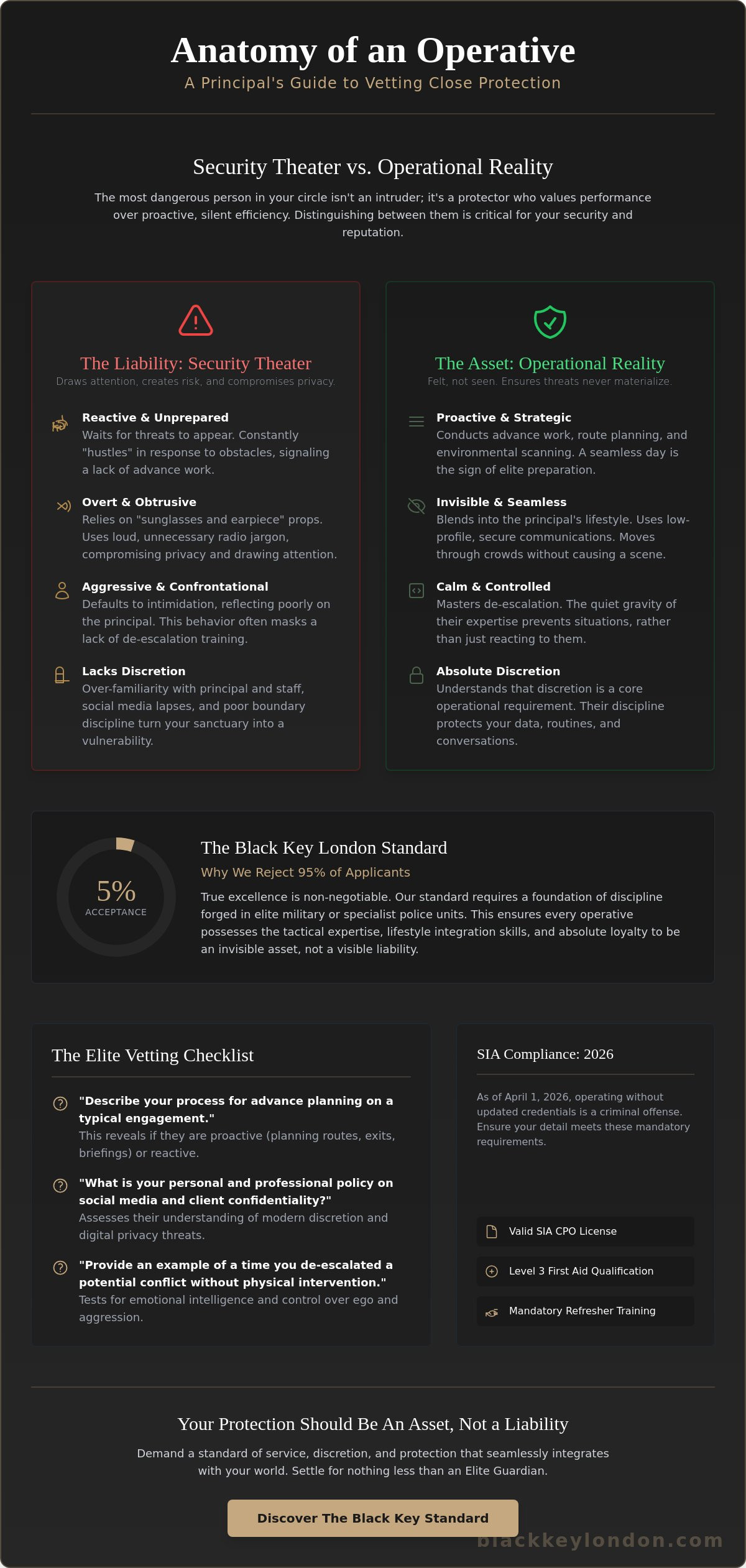
Hiring unvetted staff carries severe legal implications. As of April 1, 2026, the SIA requires all CPOs to hold a Level 3 First Aid qualification and complete mandatory refresher training before license renewal. Operating without these updated credentials is a criminal offense. Beyond the law, there's a heavy psychological toll. When security feels like a heavy presence rather than a seamless service, it creates a climate of anxiety for your family. In 2026, the role of a CPO is the precise calibration of risk mitigation and invisible logistics to ensure the principal remains both safe and unburdened.
Operational vs. Visual Security
Many agencies sell security theater. This is the sunglasses and earpiece trap where looking tough replaces actual situational awareness. It's a hollow performance. Real protection is proactive. It involves advance work, route planning, and constant environment scanning. At Black Key London, we define this as the Elite Guardian persona. It's a standard built on discipline and absolute loyalty. We don't just provide guards; we provide the people behind the principal who understand that the best result is a day where nothing happens and no one noticed you were there.
Security Theater vs. Operational Reality: Spotting the Hollywood Bodyguard
The image of the stone-faced guard in dark glasses and a coiled earpiece is a staple of cinema, but in the world of UHNWI protection, it's often a red flag. This "Security Theater" is designed to impress the onlooker rather than protect the principal. One of the most telling signs of an unprofessional CPO is a reliance on these superficial markers. True operational service is discreet. It's the quiet work that happens hours before you even leave your residence. If your security feels like a performance, you aren't being protected; you're being used as a prop.
Professionalism is defined by what doesn't happen. If your security detail is constantly reacting to obstacles or engaging in visible "hustle," they didn't do the advance work. Proactive protection means the route is cleared, the exits are identified, and the staff at your destination are already briefed. An amateur waits for a threat to appear; an elite guardian ensures the threat never has an opportunity to manifest. This level of foresight separates a battle-hardened professional from someone merely playing a role. It's the difference between a chaotic evacuation and a seamless exit.
Communication protocols offer another clear indicator of quality. Amateurs often treat radio work as a performance, using loud, unnecessary jargon in public spaces. This draws attention and compromises your privacy. Professionals prioritize secure, low-profile comms and follow international standards for conduct to ensure every action is measured. The goal is to maintain your "bubble" without alerting the world to your presence. When the comms are loud and the posturing is aggressive, the security becomes the threat to your reputation.
Signs of Security Theater
- Performative Scanning: Constant, exaggerated head movements that look like a search but lack actual focus. It's designed to look "active" for the principal's benefit rather than detecting real risks.
- Hardware Overload: Displaying tactical gear or weapons in low-threat environments like a quiet restaurant or a family event. This is a massive reputational risk that draws the wrong kind of attention.
- Artificial Aggression: Adopting a hostile posture toward waiters, valets, or members of the public. This creates unnecessary friction and makes the principal the center of a scene.
Markers of Operational Excellence
The best protection is nearly invisible. It relies on executive protection principles where the operative's positioning is calculated to a few inches. They stay close enough to act but far enough to give you space. This requires deep expertise in tactical evacuation rather than the myth of the "human shield." If an incident occurs, the priority is to remove you from the area instantly, not to engage in a prolonged confrontation. For those who demand this level of precision, integrated protection becomes a seamless part of their lifestyle, providing safety without the noise of the spotlight.
Behavioral Red Flags: Discretion, Discipline, and Boundaries
The relationship between a principal and their security detail is uniquely intimate. You share confined spaces, private travel, and sensitive family moments. This proximity demands a level of discipline that many generalist agencies fail to provide. One of the most subtle but dangerous signs of an unprofessional CPO is the erosion of professional boundaries. When a protector begins to act like a friend or a family member, they lose the objective distance required to assess threats. Complacency is the silent killer of effective protection. An elite guardian remains a trusted peer, not a social companion.
The "Fanboy" syndrome is a specific risk in the world of UHNW security. Some operatives become star-struck by the principal’s status or lifestyle. They stop looking outward for threats and start looking inward for approval. This behavior often manifests as over-familiarity or interjecting in private conversations. If your CPO is more interested in your guest list than the perimeter, they're a liability. You aren't paying for a fan. You're paying for a silent, vigilant professional who understands their place in your ecosystem.
Social media usage is another non-negotiable boundary. An unprofessional operative might post "on the job" photos or tag locations on digital platforms. This is a catastrophic breach of Operational Security (OPSEC). It provides a real-time roadmap for anyone looking to track your movements. True professionals, especially those forged in the Royal Marines or specialist police units, understand that their digital footprint must be non-existent while on duty. Privacy is the ultimate luxury, and an unprofessional CPO is often the first person to compromise it.
The Breach of Discretion
The "invisible staff" rule is a hallmark of elite service. An operative should be present enough to act but quiet enough to be forgotten. Overhearing and repeating private details is an immediate grounds for termination. The Discretion Protocol is the non-negotiable cornerstone of UHNW security. It ensures that an operative’s ears are open but their mouth remains permanently closed regarding the Principal’s private affairs. Leaking information to competitors or paparazzi isn't just unprofessional; it's a total failure of the mission.
Discipline and Personal Conduct
Readiness is a 24-hour commitment. An operative who parties off-duty or struggles with substance use cannot be trusted to react in a split-second crisis. Physical fitness is equally vital. If a CPO cannot keep up with your lifestyle, whether it's a mountain hike or a fast-paced urban itinerary, they can't protect you. The updated 2026 regulatory standards also emphasize the need for current, safety-critical training. Relying on "what I did 10 years ago" is insufficient. Elite protection requires constant evolution and a commitment to the highest modern standards of excellence.
The Elite Vetting Checklist: 5 Essential Questions for Principals
Selecting an operative is a tactical decision that requires more than a glance at a CV. You're inviting a stranger into your private life. You're trusting them with your family's safety. To avoid the signs of an unprofessional CPO, you must move beyond surface-level interviews and probe their operational methodology. Use these five questions to separate the elite guardians from the amateurs.
- "Tell me about your advance work for today’s itinerary." A professional has already mapped the route, identified the nearest trauma centers, and scouted the venue’s egress points. If they haven't done the "invisible labor" before the day begins, they aren't protecting you; they're just following you.
- "How do you manage my privacy when we are in a confined space?" Whether it's a private jet or a dressing room, an elite operative knows exactly where to stand to maintain security without intruding on your conversation. Discretion is a spatial skill.
- "What is your protocol for a non-violent confrontation with an aggressive individual?" Aggression is a failure of planning. You want a protector who uses de-escalation and subtle positioning to remove you from a scene before a hand is ever raised.
- "Can you demonstrate your understanding of my specific medical or dietary requirements?" In 2026, protection is integrated. If you have an allergy or a chronic condition, your CPO should be your first line of medical response, holding the necessary Level 3 First Aid qualifications required by the SIA.
- "How do you stay current with evolving cyber and physical threats?" The landscape changes daily. A professional invests in continuous training, moving beyond what they learned a decade ago to master modern surveillance detection and digital privacy.
Reviewing the Credentials
The baseline for any operative in the UK is a valid SIA license, which costs £204 for a three-year term. However, the license is the floor, not the ceiling. Look for specialized training in evasive driving and trauma medicine. True excellence is found in those with extensive personal bodyguard experience within the private sector. Military or police backgrounds provide the discipline, but private service requires a refined touch that the battlefield doesn't teach. We are not a security company; we are specialists in the people behind the principal.
The Trial Period: What to Look For
A trial period is essential to observe how an operative integrates into your world. Monitor how they interact with your existing hnw family staff, such as chefs or house managers. Friction with your domestic team is a major red flag. Evaluate their low-profile capability. Can they sit at a nearby table in a restaurant without drawing every eye in the room? An elite guardian adapts to sudden schedule changes with calm confidence, ensuring the logistics remain seamless while the protection remains absolute. If you require a vetting process that leaves nothing to chance, book a confidential consultation with our team to secure an operative who fits your lifestyle.
The Black Key London Standard: Why We Reject 95% of Applicants
Excellence isn't an accident; it's the result of a ruthless selection process. At Black Key London, we reject 95% of applicants who apply for operational roles. This high threshold exists because most candidates, despite their backgrounds, still exhibit the subtle signs of an unprofessional CPO that we've detailed in this guide. We don't just look for a license or a military history. We look for the "Elite Guardian" persona. This philosophy is forged in the discipline of the Royal Marines and specialist police units, then refined for the delicate environment of a private estate. Protection is a science, but lifestyle integration is an art.
Our model centers on Integrated Protection and Lifestyle Management. We recognize that a principal doesn't just need a guard; they need a seamless support structure. This requires a high level of emotional intelligence (EQ) alongside tactical proficiency. A protector must know when to step forward and, more importantly, when to fade into the background. We match every operative to the specific culture of your household. If the chemistry isn't right, the security isn't effective. One trusted individual. One relationship. This is how we ensure your safety never comes at the cost of your comfort.
The People Behind the Principal
Our vetting goes far beyond a standard criminal record check or an SIA verification. We conduct deep-dive behavioral assessments to ensure every operative possesses the loyalty and discretion we promise. Once a protector is placed, they aren't left alone. They receive ongoing mentorship and operational oversight from our founding team. This ensures that the standards established on day one are maintained for years. We provide the people behind the principal who understand that "invisible" protection is the highest form of service. Your privacy is protected by a wall of silence and a history of operational success.
Your Next Steps to Secure Professionalism
If reading this has raised concerns about your current security detail, it's time for a change. An unprofessional CPO isn't just an inconvenience; they're a risk to your family's data and your public standing. We recommend conducting a comprehensive security audit of your current team to identify vulnerabilities in their training or conduct. Transitioning from an amateur provider to an elite service should be handled with absolute discretion to prevent any disruption to your lifestyle. We specialize in these sensitive transitions, replacing liability with reliability. You deserve a protector who carries the weight of expertise without the noise of ego. Consult with our elite protection experts for a confidential review of your current security arrangements and discover the Black Key London difference.
Restoring the Standard of Elite Protection
True safety is an invisible asset. It allows you to move through the world without friction or unwanted attention. By recognizing the signs of an unprofessional CPO, you've taken the essential step of prioritizing your family's privacy over superficial "security theater." You now have the framework to demand more than just a presence; you can demand a protector who understands the balance of tactical excellence and lifestyle management. One trusted individual. One relationship.
Our firm is founded by former Royal Marines and Specialist Police officers who have operated at the highest levels of UHNW and Royal Family protection. We reject 95% of applicants to ensure only the most disciplined guardians join your inner circle. We don't just provide staff; we deliver a comprehensive model of Integrated Protection and Lifestyle Management. We are the people behind the principal, ensuring your world remains secure and your reputation stays intact.
It's time to move beyond the liability of amateurism and embrace the "Elite Guardian" philosophy. Secure your lifestyle with the elite guardians at Black Key London. You deserve a service that is as disciplined and refined as the life you lead.
Frequently Asked Questions
How can I tell if my bodyguard is actually trained or just "looking the part"?
Verify their status on the SIA public register immediately. A professional must hold a valid Close Protection license, which requires a non-refundable £204 application fee and rigorous background checks. Beyond the paperwork, watch their habits. Real training manifests as quiet "advance work" and constant environmental scanning. If they're more focused on their appearance than your egress routes, they're likely practicing security theater rather than operational protection.
Is it unprofessional for a CPO to talk to me about their personal life?
Maintaining a professional distance is a core requirement of the role. While a protector is a trusted peer, excessive personal disclosure is one of the clear signs of an unprofessional CPO. Over-familiarity compromises their objectivity and your privacy. An elite guardian understands that their role is to provide a seamless support structure, not to become a social companion or a family confidant.
What are the red flags to look for in a security company’s contract?
Watch for contracts that fail to emphasize absolute non-disclosure and specific operational standards. A professional agreement should clearly define the scope of lifestyle integration and the "invisible" nature of the service. If the contract looks like a generic guarding agreement or lacks clauses regarding digital OPSEC and social media conduct, it's a sign the firm doesn't understand the unique pressures of UHNWI service.
Can an unprofessional CPO be retrained, or should I terminate them immediately?
Fundamental lapses in discretion or discipline usually warrant immediate termination. While technical skills like first aid can be updated through the mandatory SIA refresher courses required as of April 1, 2026, behavioral red flags are rarely fixable. Loyalty and professional boundaries are forged over years of service in elite units. If these traits are missing, no amount of training will instill them.
How much should I expect to pay for a truly professional CPO in London?
Budget for an average London salary of £137,498 per year as of May 3, 2026. This rate reflects the high-stakes expertise and total discretion required for elite protection. The typical range for a qualified operative falls between £93,499 and £168,297. While lower rates exist, they often correlate with a lack of specialized training or the high-level experience found in former Royal Marines or police units.
What is the most common mistake UHNWIs make when hiring security?
The most frequent error is valuing physical size over operational intelligence. High-level protection is 90% planning and 10% reaction. Hiring a "bruiser" who lacks the EQ to navigate a private household often leads to reputational damage and a loss of privacy. You need a protector who can blend into a boardroom or a gala as easily as they can manage a tactical evacuation.
Does a CPO need to be with me 24/7 to be professional?
Elite protection is defined by a bespoke risk assessment, not constant physical proximity. A professional will design a strategy that might include residential security teams or advanced surveillance detection rather than a constant shadow. The goal is to provide safety without burdening your lifestyle. True professionalism means being exactly where they need to be, precisely when they need to be there.
How do I check a CPO’s references without compromising my own privacy?
Utilize a specialized intermediary or recruitment firm to handle the vetting process. This allows for a deep-dive into an operative’s history and performance without revealing your identity to their former employers. We are not a security company; we act as the discreet bridge between principals and the elite guardians who serve them, ensuring your privacy remains intact from the first conversation.