A dog is not a piece of equipment; it's a tactical asset that requires more rigorous vetting than your most sophisticated surveillance system. For the principal of a private estate, the search for the best security dogs is rarely about finding a pet. It's about identifying a biological layer of defense that operates with the same precision as a close protection team. You likely recognize that a high-drive animal becomes a liability without the discernment to distinguish between a trusted guest and a genuine threat. Security isn't found in raw aggression. It's found in controlled, operational discipline.
This guide clarifies the distinction between a traditional family dog and a professional protection asset tailored for the specific requirements of a UHNWI residence in 2026. We'll examine which specific breeds provide the ultimate security for elite estates while maintaining the temperament necessary for domestic life. You'll discover how to integrate these guardians into your existing protocols to ensure your home remains a sanctuary. We'll preview the top four breeds currently utilized by elite handlers to deliver absolute peace of mind through integrated protection.
Key Takeaways
- Distinguish between a visual deterrent and an active tactical defender to ensure your security asset aligns with your estate’s specific threat profile.
- Identify why proven working bloodlines are more critical than breed names when selecting the best security dogs for high-net-worth environments.
- Learn to evaluate the "off-switch" and social stability required for a protection dog to integrate seamlessly into a private family household.
- Understand the essential vetting process and the difference between sport-based training and real-world operational protection.
- Discover how elite K9 assets act as a force multiplier when integrated into a professional Residential Security Team (RST).
Understanding the Hierarchy: Guard Dogs vs. Personal Protection Dogs
Estate protection for the UHNWI requires more than a simple deterrent. It demands a sophisticated, operational asset. When evaluating the best security dogs, the primary distinction lies in the hierarchy of training. A dog is either a sensor or a weapon system. Understanding where an animal sits on this spectrum is critical for the safety of the principal and the seamless operation of a private estate.
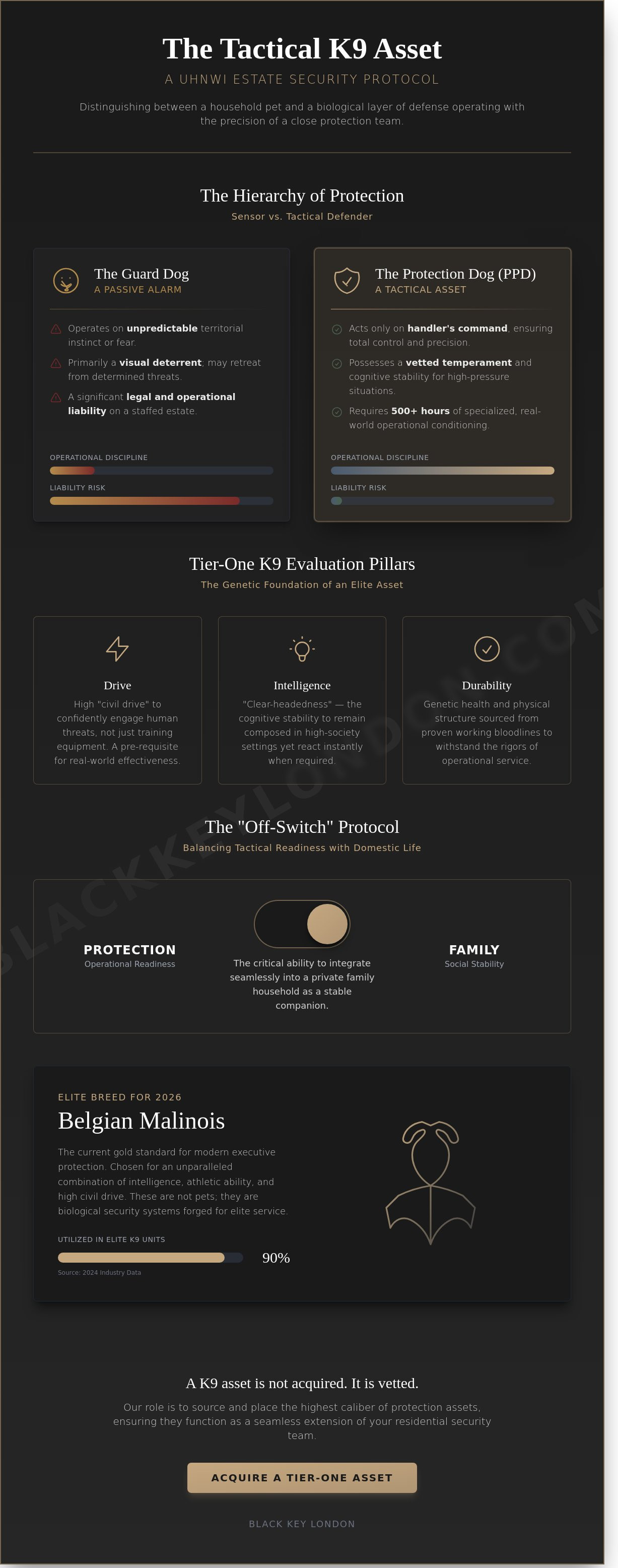
A standard guard dog alerts. A Personal Protection Dog (PPD) engages. One is a passive alarm; the other is a tactical defender. Service. Discretion. Protection. These are the pillars of an elite K9 asset. On a busy estate with a rotating staff of gardeners, housekeepers, and contractors, a dog that lacks precision becomes a significant legal and operational liability. It doesn't just need to be brave. It needs to be discerning.
The Visual Deterrent: Why Presence Matters
Psychology is the first layer of any security strategy. The mere presence of a large, alert breed often terminates a threat before a perimeter is even breached. Most opportunistic intruders seek the path of least resistance. Seeing a Belgian Malinois or a German Shepherd patrolling a boundary creates an immediate psychological barrier. The history of guard dogs demonstrates that their most consistent value is as an early warning system. A dog’s bark is a biological sensor that outpaces digital technology in reliability.
However, a dog that has not undergone professional bite-work training is limited. Its reaction is rooted in territorial instinct or fear, both of which are unpredictable. Without the 500 plus hours of specialized conditioning required for elite service, a dog may retreat when faced with a determined, professional intruder. It provides a sense of security, but not necessarily the reality of it.
The Protection Asset: Precision and Control
True protection is defined by control, not aggression. The best security dogs are those trained to order, operating with a level of discipline forged in environments similar to Royal Marines or specialist police units. These animals don't act on impulse. They wait for the handler’s command. This "trained to order" capability ensures that the dog remains a composed member of the household until a specific threat threshold is crossed.
Total obedience is the baseline for an elite PPD. In a high-pressure environment, the dog must maintain a 100 percent recall rate. It is an invisible but essential support structure. This level of refinement allows the principal to live without concern, knowing the asset is always under control.
- Vetted Temperament: Only a small percentage of dogs possess the cognitive stability for this work.
- Operational Service: The dog must function as a seamless extension of the security team.
- Bespoke Training: Every animal is calibrated to the specific lifestyle and environment of the principal.
Black Key London is not a security company. We are the people behind the principal, sourcing and placing the highest caliber of protection assets. We understand that excellence is not an accident; it is the result of rigorous, battle-hardened standards.
The Elite Breeds: Selecting the Best Security Dogs for 2026
Identifying the best security dogs for a private estate requires looking beyond the kennel club certificate. Bloodlines dictate the outcome. For a principal in 2026, the focus has shifted toward "clear-headedness." This is the psychological ability to maintain total composure in a high-society setting while possessing the "on-switch" required for immediate tactical intervention. We evaluate every prospect through the lens of three core pillars: drive, intelligence, and physical durability. A dog that flinches at a camera flash or a slamming car door has no place on a professional security detail.
The selection process is a matter of professional vetting. We prioritize animals with a high "civil drive," meaning they're comfortable engaging a human threat rather than just a training sleeve. This requires a specific genetic heritage often found in specialized European breeding programs. These animals are not pets; they're biological security systems. Reliability. Discretion. Protection.
The Belgian Malinois: The Tactical Choice
The Belgian Malinois is the current gold standard for modern executive protection. Industry data from 2024 confirms that approximately 90% of specialized military and police units globally now favor this breed over traditional alternatives. They offer an unmatched work ethic and the agility to scale six-foot walls. However, they're high-intensity assets. They require four to five hours of daily engagement to remain sharp. For the principal, they represent a precision tool that thrives in complex, fast-moving environments.
The German Shepherd: The Versatile Guardian
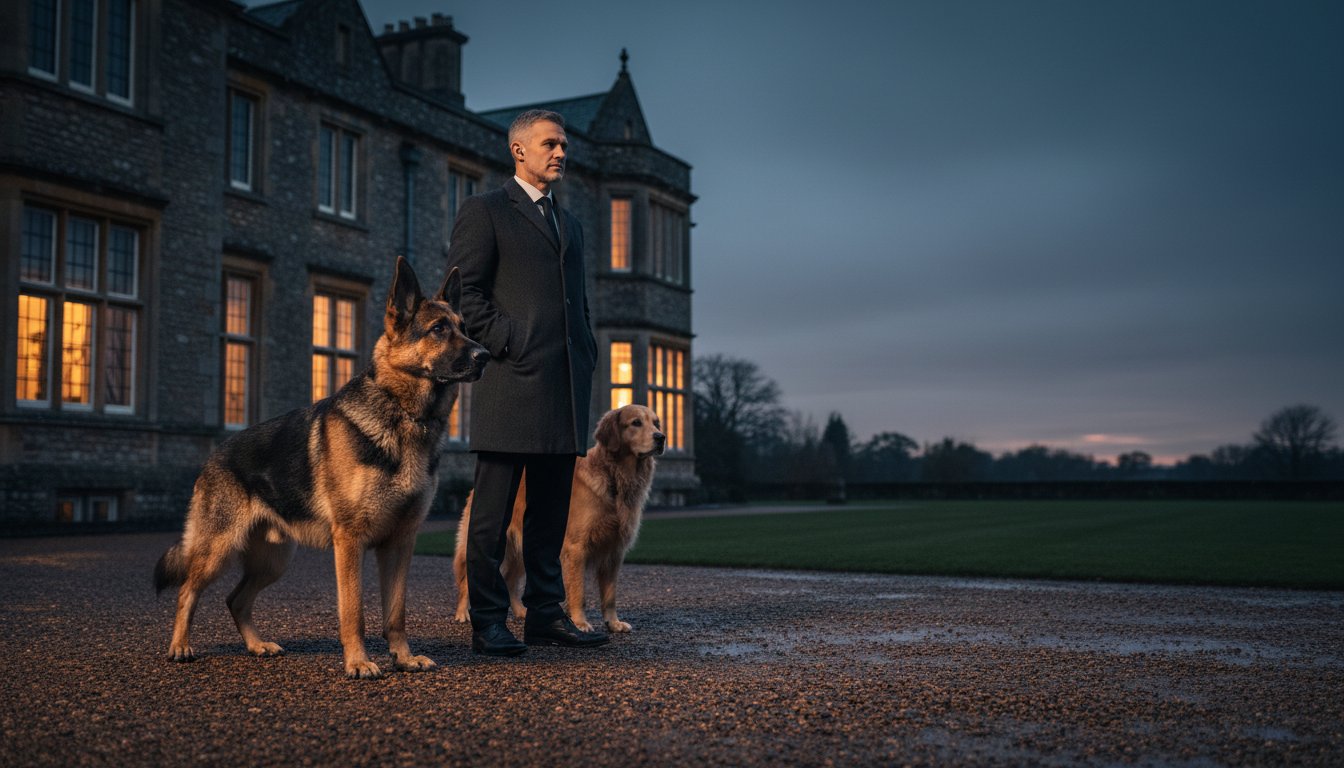
The German Shepherd remains the most recognizable deterrent on the planet. The distinction between "show-lines" and "working-lines" is absolute. Show-line dogs often lack the nerve for high-stakes estate work. We source exclusively from Czech or East German working bloodlines bred for substance and stability. These animals provide a balanced profile: a loyal family companion by day and a fierce defender by night. Finding the right people behind the principal to manage these assets ensures a seamless integration into the household.
The Giant Schnauzer and Boerboel: Power and Privacy
For those seeking a more discreet aesthetic, the Giant Schnauzer is a formidable alternative. They're naturally suspicious of strangers and possess a deep, resonant bark that serves as an effective early warning system. Conversely, the Boerboel is a 150-pound powerhouse from South Africa. Bred specifically for estate defense, they're intensely territorial and act as an immovable barrier. They don't seek the spotlight; they simply exist to dominate the space. Selection depends entirely on the lifestyle and aesthetic requirements of the estate.
The "Off-Switch": Balancing Protection with Family Life
The primary misconception regarding the best security dogs is the belief that they exist in a state of perpetual aggression. This is false. A dog that is always "on" isn't a protector; it's a liability. Within the context of a UHNW household, a dog must possess a socially stable temperament that allows it to transition from a vigilant guardian to a calm companion in seconds. This "off-switch" isn't a mechanical function but a result of elite breeding and rigorous environmental conditioning. It's the difference between a volatile animal and a sophisticated security asset.
Elite training ensures the dog distinguishes between a genuine threat and a routine domestic event. While a standard guard dog might perceive a delivery driver as an intruder, a professionally trained estate dog evaluates intent and context. The principal serves as the secondary handler. This relationship ensures a seamless chain of command within the domestic sphere. It's about integrated protection. The dog doesn't just live on the estate. It understands the ecosystem of the estate.
Stability in Social Situations
Operational excellence requires a dog that remains indifferent to the clatter of silver or the arrival of a private jet. We prioritize dogs that have undergone over 600 hours of environmental exposure. They're trained to remain composed during large dinners, high-stakes meetings, and international travel. A stable dog doesn't react to "strange" behavior, such as a guest gesturing wildly during a story or a child running past. It monitors. It assesses. It waits for a specific command or a clear, aggressive breach of the perimeter. This level of discernment is what defines the best security dogs in a professional capacity.
Safety Around Children and Staff
The myth of the "one-man dog" has no place in a modern estate. A protector that only obeys one individual is a risk to the rest of the family and the household team. We facilitate family-integrated protection. This means the dog recognizes household staff and children as part of the "inner circle" to be defended, not managed. Establishing clear boundaries is essential. We implement specific command protocols for staff to ensure the dog respects their presence while maintaining its defensive posture toward outsiders.
High-drive breeds require clear leadership. The household must provide a structured environment where the dog understands its rank. This isn't about dominance; it's about clarity. When the lines of authority are precise, the dog feels secure. A secure dog is a predictable dog. In the world of close protection, predictability is the foundation of safety. Discretion. Stability. Results. This is the standard we demand for every placement.
Sourcing and Training: How to Acquire a Tier-One Security Dog
Acquiring a K9 for estate protection is a high-stakes strategic decision. It's an investment in a living asset that requires the same level of due diligence as hiring a close protection team. Many providers offer off-the-shelf "pre-trained" animals, yet buying without a rigorous vetting process is a significant risk. You must distinguish between sport dogs and operational protectors. Schutzhund, while impressive, is a sport governed by predictable patterns and points. Real-world protection requires a dog to navigate chaotic environments and make independent decisions under pressure. The best security dogs aren't just athletes; they're composed thinkers with high environmental stability.
The Procurement Process
Selecting the right animal starts with a clear objective. While a puppy offers the chance to build a bond from day one, it carries the risk of unknown physical or temperamental development. Many principals prefer the "Green Dog" approach. These are young adults, typically 12 to 24 months old, who've passed initial screenings for drive and nerves but haven't received finished training. This allows for a bespoke program tailored to your specific estate. Health clearances are absolute. We demand certified results for hip and elbow dysplasia, often through the BVA or SV, alongside genetic testing for conditions like Degenerative Myelopathy. A dog with poor physical foundations is a liability that will fail when the stakes are highest.
Advanced Protection Training Protocols
Tier-one training focuses on clinical efficiency rather than aggression. Every movement is controlled. Training protocols must include:
- Targeting and Bite-Work: The dog is trained to strike specific areas to neutralize a threat quickly. This is a technical skill, not an emotional reaction.
- Search and Find: A vital capability for estate life. The K9 is taught to clear a perimeter or sweep a residence before the principal enters, identifying hidden intruders with silent alerts.
- The "Out" Command: This is the most critical safety feature. A professional protection dog must release a bite instantly on a single command, regardless of the level of adrenaline.
Maintenance is a permanent commitment. A K9's skills are perishable; they degrade without regular, high-intensity training sessions. The relationship is a partnership. The handler must be trained to lead with the same level of discipline expected of the dog. Our approach, forged in the Royal Marines and specialist police units, ensures that your security asset remains sharp and reliable. We don't just provide a dog; we facilitate a lifestyle of integrated safety.
To discuss the placement of a bespoke K9 asset for your estate, contact our specialist team for a confidential consultation.
The Integrated Approach: K9s and Residential Security Teams
Estate protection is a symphony of layers. It isn't enough to simply have a patrol; true safety requires a synchronized defense. Black Key London integrates K9 assets into a wider, more sophisticated strategy. We view the dog as a force multiplier for our human Residential Security Teams (RST). This isn't about aggression. It's about awareness. A dog provides a 360-degree sensory perimeter that technology alone cannot replicate. Service. Discretion. Protection.
Managing the logistics of a security dog within a staffed household requires a delicate touch. The animal must be "invisible" until the moment it's required. Our approach ensures that the dog's presence doesn't disrupt the principal's lifestyle or the household's flow. We focus on refined discipline. This means the dog is as comfortable in a quiet study as it is on a perimeter sweep. Choosing the best security dogs requires an understanding of how they interact with human handlers and household staff alike.
Synergy Between Human and Canine
A dog's senses complement the surveillance technology of a professional RST. While a thermal camera can be obstructed by dense foliage or heavy rain, a dog's olfactory system remains operational. Research indicates a trained dog can detect a human scent from over 200 meters away depending on wind conditions. This provides the team with vital seconds of early warning. The professional K9 handler is the bridge in this relationship. They translate the dog's subtle behavioral shifts into actionable intelligence for the Close Protection Officers. This coordination ensures that the estate's response is proactive, not reactive.
Bespoke Security Management
We don't believe in "off-the-shelf" solutions. Each deployment is tailored to the specific risks and daily routines of the principal. The best security dogs are those that disappear into the background, providing a silent layer of reassurance. At Black Key London, we aren't a security company in the traditional sense. We are a specialist consultancy forged in the Royal Marines and specialist police units. We understand that hardware and animals are tools, but the people behind the principal are the final layer of defense. Human trust is the foundation of everything we do.
Our methodology is built on a history of real-world operational success. If you require a security solution that balances elite protection with absolute privacy, we invite you to begin a dialogue. Contact Black Key London for a confidential estate security review to discuss how we can integrate specialist K9 assets into your residential protection strategy.
Forging a New Standard in Estate Protection
Finding the best security dogs for a 2026 landscape requires more than just selecting a breed; it requires an uncompromising commitment to tier-one standards. A successful integration relies on the animal's ability to switch from a high-stakes guardian to a composed family companion. This balance is achieved through rigorous vetting and training protocols that mirror the discipline of elite operational units. True security is a layered discipline. It's the seamless coordination between a highly trained K9 and a professional Residential Security Team that ensures a principal's peace of mind.
Black Key London isn't a generalist security firm. We're specialists in UHNW lifestyle and security integration. Our foundation was built by former Royal Marines and specialist police officers who bring a battle-hardened reliability to the private sector. We operate with the quiet gravity of expertise. Total discretion isn't just a promise; it's our core operating principle. We understand the unique pressures of managing a global estate and provide the invisible support structure necessary for you to live without concern.
Consult with our elite security specialists for a bespoke estate protection strategy.
Your safety is our priority. We look forward to securing your legacy with the precision it deserves.
Frequently Asked Questions
Which dog is the best for home security?
The German Shepherd is the premier choice for home security because of its analytical nature and physical presence. It offers a balanced temperament that allows it to distinguish between a genuine threat and a welcome guest. This breed provides the composed, reassuring protection required for high-value estates. It's a disciplined guardian that fits seamlessly into the private life of a principal.
Is a German Shepherd better than a Belgian Malinois for family protection?
The choice depends on the principal's lifestyle, but German Shepherds often suit family environments better due to their natural "off-switch" at home. Belgian Malinois are elite athletes with higher intensity levels that require constant engagement. Both breeds are frequently cited as the best security dogs for UHNWI environments. The Shepherd provides a more understated authority within a domestic setting.
Can a protection dog be a good family pet?
A professionally trained protection dog is an exceptional family pet that offers both loyalty and safety. These dogs are socialized from a young age to be gentle with children and composed in social settings. They aren't aggressive machines; they're the people behind the principal in canine form. Their training ensures they remain calm and affectionate until a specific threat is identified.
How much does a fully trained protection dog cost in the UK?
Elite protection dogs in the UK typically command an investment between £20,000 and £60,000 based on current industry standards. This price reflects the rigorous selection process and thousands of hours of specialized training. It covers health clearances, temperament testing, and advanced operational skills. You're investing in a vetted asset that provides 24-hour security and total peace of mind.
Do I need a license to own a security dog in London?
You don't need a specific personal license to own a protection dog for private residential use in London. Owners must simply comply with the Guard Dogs Act 1975 and the Dangerous Dogs Act 1991. These regulations require that the dog is kept under control and that warning signs are displayed. Our methodology ensures all legal standards are met for seamless estate integration.
What is the difference between a guard dog and a personal protection dog?
A guard dog is trained to protect a perimeter or property, often with limited human interaction. A personal protection dog is trained to protect the principal and their family specifically. The difference lies in the level of sophistication and socialization. Personal protection dogs travel with the family, live in the home, and provide a discreet layer of integrated security.
How long does it take to train a dog for estate security?
It takes between 18 and 24 months to train a dog to an elite operational standard. This process begins with early socialization and moves into specialized scent work and threat neutralisation. We don't believe in shortcuts; excellence is forged through consistent, high-stakes discipline. By the end of this period, the dog is a refined professional ready for any environment.
Can an executive protection dog travel internationally?
Executive protection dogs can travel internationally provided they meet the destination's health and veterinary requirements. The UK Government’s Pet Travel Scheme (PETS) allows for streamlined movement into many countries with a valid animal health certificate. We coordinate these logistical details to ensure the dog's transition is as seamless as the principal's own travel. Protection should never stop at the border.