
What if the greatest threat to your family’s privacy isn’t a digital breach, but the individual serving dinner? You understand that your home is your ultimate sanctuary. However, inviting staff into your private sphere creates an inherent vulnerability that traditional agencies often overlook. It's a calculated risk. One that requires more than a handshake and a basic reference.
Mastering secure household staff vetting UK is now a critical operational requirement. With civil penalties for Right to Work breaches reaching £45,000 per worker as of 2026, the margin for error has disappeared. This guide provides the protocols to protect your assets and reputation from insider leaks. We deliver the clarity you need to hire with absolute confidence.
We will detail a repeatable framework for domestic integrity. This includes navigating the Data (Use and Access) Act 2025 and the new data subject rights effective June 19, 2026. You’ll see how AI-driven OSINT, now used by 70% of risk professionals, identifies behavioral patterns that traditional checks miss. Service. Discretion. Protection. These are the people behind the principal.
Key Takeaways
- Shift your security focus from physical hardware to human integrity by identifying the behavioral markers of an "insider threat."
- Implement a multi-tiered framework for secure household staff vetting UK that ensures every hire is cleared through rigorous identity and DBS verification.
- Secure your digital perimeter using advanced OSINT tools to detect social media vulnerabilities and hidden relationships that could compromise your privacy.
- Make discretion legally enforceable by integrating robust Non-Disclosure Agreements (NDAs) with modern UK GDPR compliance protocols.
- Adopt the "Black Key Standard"—a methodology forged in the Royal Marines—to transform your hiring from simple recruitment into integrated lifestyle protection.
The Reality of Internal Risk: Why Secure Household Staff Vetting is Non-Negotiable
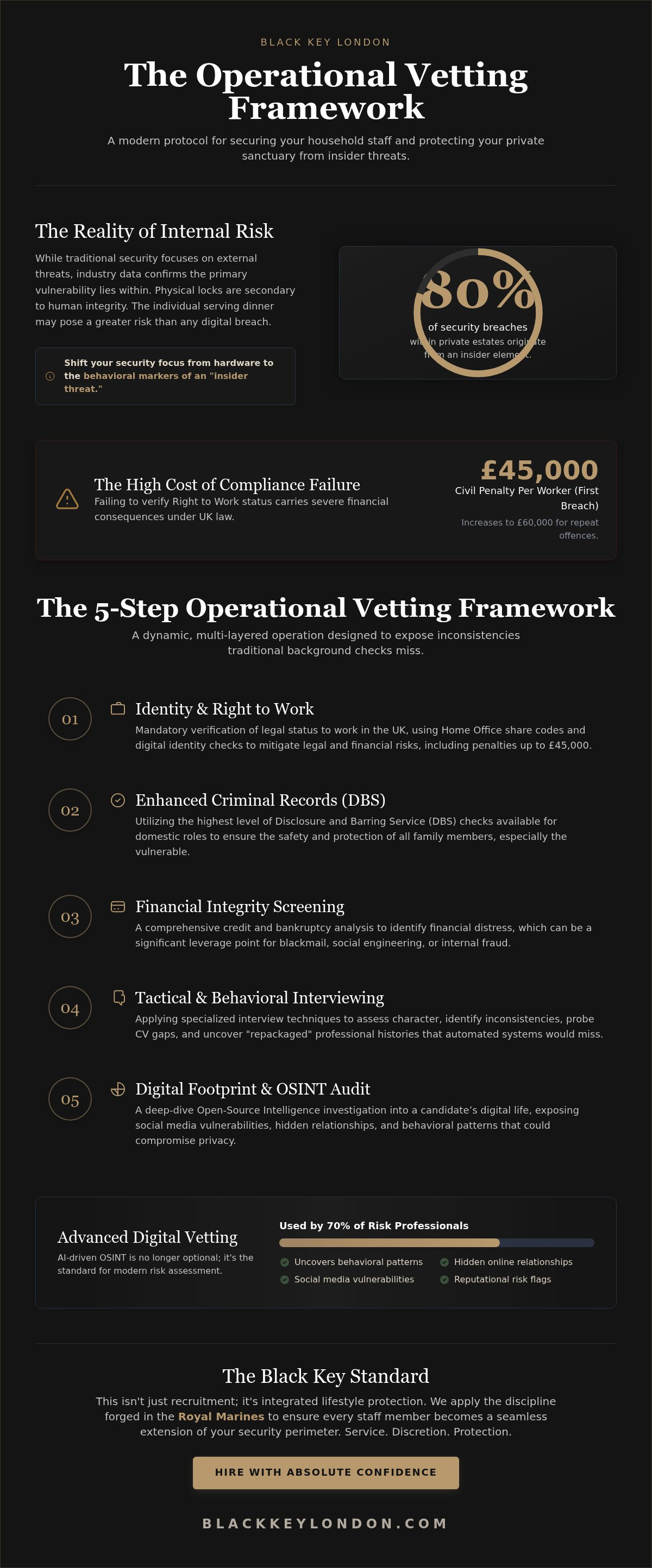
Industry data in 2026 confirms a stark reality for the UHNW community: 80% of security breaches within private estates originate from an "insider" element. While high-end security hardware provides a necessary barrier, it cannot defend against the individual who already holds the keys. Physical locks are secondary to human integrity. Secure household staff vetting UK is the only mechanism capable of neutralizing the insider threat before it crosses your threshold. It is the foundation of a stable home.
A failure in vetting is rarely just a financial loss. While theft remains a constant risk, the true cost is often reputational. A single leak to the press or a compromised social media post can dismantle years of carefully guarded privacy. This is the weight of the modern household. Service. Discretion. Protection. These are not just words; they are the psychological contract you establish with every new hire. When that contract is broken, the damage is often permanent.
The Evolution of Domestic Threats
The landscape of risk has shifted significantly. In 2026, the threat isn't just a missing heirloom; it's sophisticated social engineering. Your "friendly gardener" may have legitimate access to the grounds, but if they lack the necessary digital hygiene, they become a vulnerability in your smart home network. They are a soft target for those seeking leverage against you. We define "operational domestic risk" as the potential for any staff member to inadvertently or maliciously compromise the physical, digital, or reputational sanctuary of a principal. We look beyond basic criminal records. We examine the different UK security vetting levels to ensure your staff meet the same rigorous standards expected in high-stakes government environments.
The "People Behind the Principal" Philosophy
We don't view your staff as "help." They are professionals. Every chauffeur, housekeeper, and estate manager acts as an extension of your security perimeter. At Black Key London, we integrate these individuals into a broader integrated protection strategy. This is a shift from "hiring help" to "recruiting professionals." It requires a tactical mindset that most recruitment agencies simply do not possess.
We apply the discipline forged in the Royal Marines to the private home. By viewing domestic staff as part of an operational unit, we ensure that your privacy is not left to chance. You aren't just hiring for a role; you're recruiting the people behind the principal. One trusted individual. One relationship. Total peace of mind.
The 5-Step Operational Vetting Framework for UK Households
A standard background check is a snapshot in time. It is often static and easily manipulated. For a principal, secure household staff vetting UK must be a dynamic, multi-layered operation. We don't rely on automated apps that simply tick boxes. We apply a tactical framework designed to expose inconsistencies that traditional agencies miss. This process ensures that every individual entering your private estate has been scrutinized with the same rigor we applied in the Royal Marines and specialist police units. It's about granular detail.
- Step 1: Identity and Right to Work. We verify the legal right to reside and work in the UK using Home Office share codes and digital verification.
- Step 2: Enhanced Criminal Records. We utilize the highest level of disclosure available for domestic roles to protect vulnerable family members.
- Step 3: Financial Integrity. A credit and bankruptcy analysis identifies potential leverage points for social engineering or fraud.
- Step 4: Tactical Interviewing. We conduct behavioral assessments to identify CV gaps and "repackaged" professional histories.
- Step 5: Digital Audit. A deep-dive OSINT investigation into the candidate's digital footprint and social connections.
Identity and Right to Work Compliance
Compliance is a legal shield. As of May 2026, the civil penalty for employing an individual without the legal right to work is £45,000 per worker for a first breach. This increases to £60,000 for repeat offences. From October 2026, these requirements expand to include self-employed contractors and individuals sourced via online platforms. Physical passports are no longer sufficient for most non-British or Irish staff. We mandate the use of the official government online checking service to verify digital share codes. This prevents the sophisticated documentation fraud that often bypasses standard recruitment software.
The Enhanced DBS and Beyond
A standard check is insufficient for staff with unsupervised access to your family. We insist on an Enhanced check from the Disclosure and Barring Service (DBS), which includes a search of the "barred lists" for those working with children or vulnerable adults. The government fee for this level of scrutiny is £49.50, a small price for clarity. However, it's vital to recognize the limitations. A DBS check only tracks UK-based records; it doesn't provide visibility into a candidate’s history in other jurisdictions. For international hires, we supplement this with local police certificates and global sanctions list monitoring. If you require a higher level of certainty, our household staff recruitment process incorporates these global protocols as standard.
Financial stability is the next layer. We analyze credit histories not to judge wealth, but to identify risk. A candidate under significant financial pressure is a candidate who can be compromised. We look for patterns of debt or undisclosed bankruptcies that suggest a lack of personal discipline or a motivation for theft. This is how we ensure domestic integrity remains absolute. Service. Discretion. Protection.
Advanced Vetting: Digital Sanctity and OSINT in 2026
In 2026, a criminal record check is merely the baseline. While the Disclosure and Barring Service (DBS) remains a vital component of the process, it only captures documented history. It doesn't capture intent. It doesn't capture digital negligence. Modern secure household staff vetting UK requires a shift toward Open Source Intelligence (OSINT). With 70% of risk professionals now integrating OSINT into their workflows, the digital footprint of a candidate has become as significant as their professional references. We look for the gaps between the CV and the digital reality.
The speed of these investigations has transformed. AI-enabled OSINT tools are now 20 times faster than manual searches, allowing us to map a candidate’s global associations in minutes. This is critical for UHNW households where staff have intimate access to private schedules and sensitive locations. We don't just look for "red flags." We look for patterns of behavior that suggest a lack of discretion. Service. Discretion. Protection. This is the standard we uphold.
Social Media and Digital Footprint Audits
Your staff’s social media habits are your direct security risk. A housekeeper posting a seemingly innocent "day at work" photo can inadvertently expose your estate’s layout or your family’s location via metadata and geotags. We conduct rigorous audits to identify "leaky" privacy settings. Our team analyzes past affiliations to ensure they align with your household’s values. Under the Data (Use and Access) Act 2025, we navigate these checks with legal precision, utilizing "recognised legitimate interests" to process data while maintaining total compliance. We protect your digital perimeter as fiercely as your physical one.
Financial Integrity and Credit Vetting
Financial stability is a prerequisite for domestic integrity. We analyze credit histories to identify staff members who may be vulnerable to external coercion. Significant personal debt is a known lever for social engineering. If an individual is under extreme financial pressure, they become a target for those seeking "insider" information. We establish a financial baseline for senior roles, such as Estate Managers or PAs, who manage household budgets. This is not an invasion of privacy. It's a protective measure. By identifying "lifestyle vs. income" discrepancies, we prevent fraud before it occurs. We maintain the trust-discretion balance by conducting these checks through a professional, transparent framework. The people behind the principal must be beyond reproach.
Elite vetting often requires the expertise of private investigators. At Black Key London, our background in specialist police units allows us to conduct deep-dive inquiries that standard agencies cannot replicate. We don't just hire; we recruit professionals who understand the gravity of their environment. This is integrated protection in its purest form.
Legal Implementation: Contracts, NDAs, and GDPR Compliance
Vetting doesn't end when a candidate passes a background check. It solidifies when that individual signs a contract that makes discretion a legal mandate. Effective secure household staff vetting UK requires a legal infrastructure that mirrors the operational rigor of our field teams. We don't rely on generic templates. We utilize ironclad agreements that define the boundaries of your private life. This is the final layer of the perimeter.
The contract is where the psychological contract becomes a professional obligation. It must prioritize security as much as service. We ensure that every agreement includes provisions for immediate termination in the event of a security breach. This isn't about being punitive; it's about maintaining the integrity of the household. If you require absolute certainty, our confidential household staffing consultation can help align your legal documents with elite security standards.
Drafting the "Ironclad" NDA
A standard confidentiality clause is insufficient for a UHNW environment. You need a Non-Disclosure Agreement (NDA) that explicitly prohibits "tell-all" memoirs, social media mentions, and the sharing of any household imagery. These documents must be comprehensive. They should outline the specific consequences of a breach to act as a genuine deterrent. We align these agreements with the same executive protection standards we apply to close protection officers. Discretion is not a suggestion. It's a requirement of the role.
GDPR Responsibilities for Family Offices
Managing staff data is a significant regulatory burden. The Data (Use and Access) Act 2025 introduced reforms that came into force on February 5, 2026. These rules changed how you must process "recognised legitimate interests" for vetting. Furthermore, a new right for individuals to complain directly to a data controller (the employer) takes effect on June 19, 2026. This requires a formal acknowledgment and response process that most private households aren't prepared for. To avoid Information Commissioner's Office (ICO) fines, your vetting documents must be stored with military-grade encryption.
- Data Retention: Establish clear protocols for how long you keep vetting records for unsuccessful candidates.
- The Right to be Forgotten: Ensure your systems allow for the permanent deletion of former staff data upon request, unless a legal basis for retention exists.
- CCTV Monitoring: Your employment contracts must explicitly state how and why staff are monitored within the estate to remain compliant with UK privacy laws.
We view the initial trial period as an active phase of the vetting process. It's an opportunity for behavioral monitoring. During these first 90 days, we look for subtle deviations in conduct that digital checks might miss. One trusted individual. One relationship. Total legal and operational security.
The Black Key Standard: Why Elite Vetting Requires Operational Expertise
Standard recruitment agencies trade in volume. We trade in trust. At Black Key London, we don't operate as a traditional agency; we are an integrated protection and lifestyle management firm. Our methodology for secure household staff vetting UK is built on the rigorous protocols we forged in the Royal Marines and specialist police units. We don't just look for a candidate who can perform a task. We look for a professional who understands the gravity of their environment. This requires a level of operational service that generalist firms cannot replicate.
Our background allows us to see what others miss. We understand that a CV is a polished document, but character is revealed through pressure and history. We apply a tactical mindset to every hire, ensuring that the people you bring into your home are as disciplined as the ones who protect your perimeter. It's about more than just a background check. It's about ensuring total domestic integrity.
The Military-Grade Vetting Protocol
We apply the principles of National Security Vetting to the private sector. This isn't a passive exercise. It involves a "vouching" system where candidates are often sourced from our own elite network of trusted professionals. We focus on "the people behind the principal" because we know that your staff are the ones who see you at your most vulnerable. Our process is exhaustive. We look for the character traits that suggest long-term reliability and a deep-seated respect for privacy. Service. Discretion. Protection. This is the Black Key standard. It's a commitment to excellence that we've carried from our military service into the world of private estates.
Securing Your Household Today
Vetting is the first step in a broader, integrated strategy. For many of our clients, this process naturally transitions into the deployment of residential security teams. This creates an "Invisible Shield" where every member of your staff—from the estate manager to the chauffeur—is aligned with your security profile. The onboarding process feels like a premium service rather than an interrogation. It's a seamless transition that prioritizes your comfort while maintaining absolute oversight. We ensure that your home remains a sanctuary, not a source of concern.
The relationship is central to everything we do. One trusted individual. One relationship. We provide the essential support structure that allows you to live your life with total peace of mind. If you require a higher standard of secure household staff vetting UK, we invite you to start a confidential conversation with our team. Secure your domestic integrity with Black Key London and experience the quiet gravity of true expertise.
Establishing Absolute Integrity Within Your Private Estate
Protecting your home in 2026 requires a synergy of digital OSINT, legal precision, and behavioral analysis. You recognize that physical security is only as strong as the human element within it. Implementing secure household staff vetting UK isn't a one-time task; it's a continuous commitment to the sanctity of your private life. We've moved beyond simple background checks into a world where digital habits and financial stability are the new perimeters of safety. True domestic integrity is built on granular detail and constant vigilance.
Black Key London was forged in the Royal Marines and specialist police units to meet this exact need. We don't just screen candidates. We recruit professionals who respect the gravity of their environment. Our bespoke protocols guarantee absolute discretion for every principal. Consult Black Key London for Discrete Staff Vetting to ensure your household operates with total oversight. Your sanctuary deserves the highest standard of excellence. Let us provide the invisible shield that allows you to live without concern. Service. Discretion. Protection.
Frequently Asked Questions
Is it legal to check a domestic staff member’s social media in the UK?
Yes, it's legal under the Data (Use and Access) Act 2025. You must establish a "recognised legitimate interest" as defined by the legislation that came into force on February 5, 2026. Focus purely on security vulnerabilities and behavioral reliability. Avoid processing data related to protected characteristics to remain compliant with UK GDPR divergence. Professional secure household staff vetting UK ensures these audits are conducted without overstepping legal boundaries.
How long does a comprehensive household vetting process take?
A thorough vetting process generally requires 10 to 14 working days. While a Basic DBS can be returned within 48 hours, a comprehensive operational audit involves manual reference verification and deep-dive OSINT analysis. We prioritize accuracy over speed. This timeframe allows for the identification of sophisticated inconsistencies that automated systems often miss. Quality requires patience. Service. Discretion. Protection.
What is the difference between a Standard and Enhanced DBS check?
A Standard check covers unspent convictions and cautions; an Enhanced check adds spent convictions and "barred list" searches. The government fee for a Standard check is £21.50, while the Enhanced version is £49.50. For staff with unsupervised access to children or vulnerable adults, the Enhanced check is a mandatory operational requirement. It provides the highest level of criminal record transparency available in the UK.
Can I vet international staff who have recently moved to the UK?
You can vet international staff by requesting a Certificate of Good Conduct from their home country's embassy or police force. A UK DBS check only monitors records within this jurisdiction. We supplement this with global sanctions monitoring and digital Right to Work verification via the Home Office share code system. This ensures a seamless transition for staff while maintaining your household’s security standards. It's about granular detail.
How do I handle an NDA if the staff member refuses to sign?
Refusal to sign a Non-Disclosure Agreement (NDA) should be treated as a terminal red flag. In a high-stakes domestic environment, discretion is the baseline for employment. If a candidate is unwilling to commit to legal confidentiality, they cannot be trusted with the "People Behind the Principal" philosophy. We recommend terminating the recruitment process immediately to protect your family’s privacy. No exceptions.
What are the red flags to look for during a domestic staff interview?
Look for unexplained CV gaps and a lack of specific detail when discussing past roles. Behavioral indicators, such as criticizing previous principals or avoiding eye contact during financial discussions, are significant markers of risk. Successful secure household staff vetting UK relies on identifying these subtle deviations in character. If the narrative doesn't align with the data, the candidate is a liability.
Do I need to re-vet staff after they have been employed for several years?
We recommend re-vetting senior staff every 3 years or implementing proactive, continuous monitoring. A staff member's risk profile can change due to new financial pressures or social associations. Technology in 2026 allows for ongoing collection of public data to detect emerging threats. Regular audits ensure that the standard of domestic integrity you established at the point of hire remains absolute. One trusted individual. One relationship.
How much does professional household staff vetting cost in the UK?
Professional vetting costs involve government fees and agency administration charges. A Basic or Standard DBS check costs £21.50, while an Enhanced check is £49.50. Beyond these fixed costs, vetting and placement agencies typically charge a fee ranging from 15% to 25% of the candidate's annual gross salary. This investment covers the operational expertise required to conduct deep-dive OSINT and behavioral assessments. Total peace of mind is the objective.