

While headlines suggest a city in constant flux, the data tells a more nuanced story; in the 12 months leading to March 2023, the Metropolitan Police recorded 108 homicides across a population of nearly nine million. It's a figure that demands scrutiny rather than alarm. You've likely seen the conflicting reports regarding the london homicide rate and felt a natural concern for your family's security in the capital. It's difficult to reconcile official government statistics with the visceral nature of social media clips.
We understand that for a principal, safety isn't a feeling; it's a requirement. Service. Discretion. Protection. This article delivers a cold, operational briefing on London’s safety trajectory for 2026. We'll move past the noise to examine the reality of targeted versus random crime and how London compares to other global hubs. By the end, you'll have a clear, bespoke framework for assessing urban risk and ensuring your lifestyle remains both seamless and secure.
Key Takeaways
- Analyze the objective data behind the london homicide rate, which recently hit an eleven-year low despite the capital’s expanding population.
- Compare London’s safety profile against global peers like New York and Paris to understand its standing as a secure hub for international residence.
- Bridge the gap between viral social media narratives and official statistics to separate perceived urban risk from operational reality.
- Identify the nuances of current violent crime trends, specifically the decline in youth-related incidents and the reality of UK knife versus firearm statistics.
- Learn how to evolve from population-level data to "Integrated Protection," a bespoke strategy tailored for the lifestyle management of high-profile principals.
Mapping the 2026 London Homicide Rate: The Definitive Data
Urban safety is best understood through the clinical lens of the homicide rate per capita. This metric serves as the primary benchmark for assessing the security of any global capital. It eliminates the noise of raw numbers by calculating fatalities per 100,000 residents. For the high-net-worth individuals we support, this data provides the clarity required for informed residency and investment decisions. Understanding the historical homicide rates in London reveals a city that has refined its approach to public safety through disciplined, intelligence-led intervention. The Metropolitan Police and the Violence Reduction Unit (VRU) have moved beyond reactive policing. They now employ a methodology rooted in operational excellence and preventative strategy.
The 2025/2026 Statistical Milestone
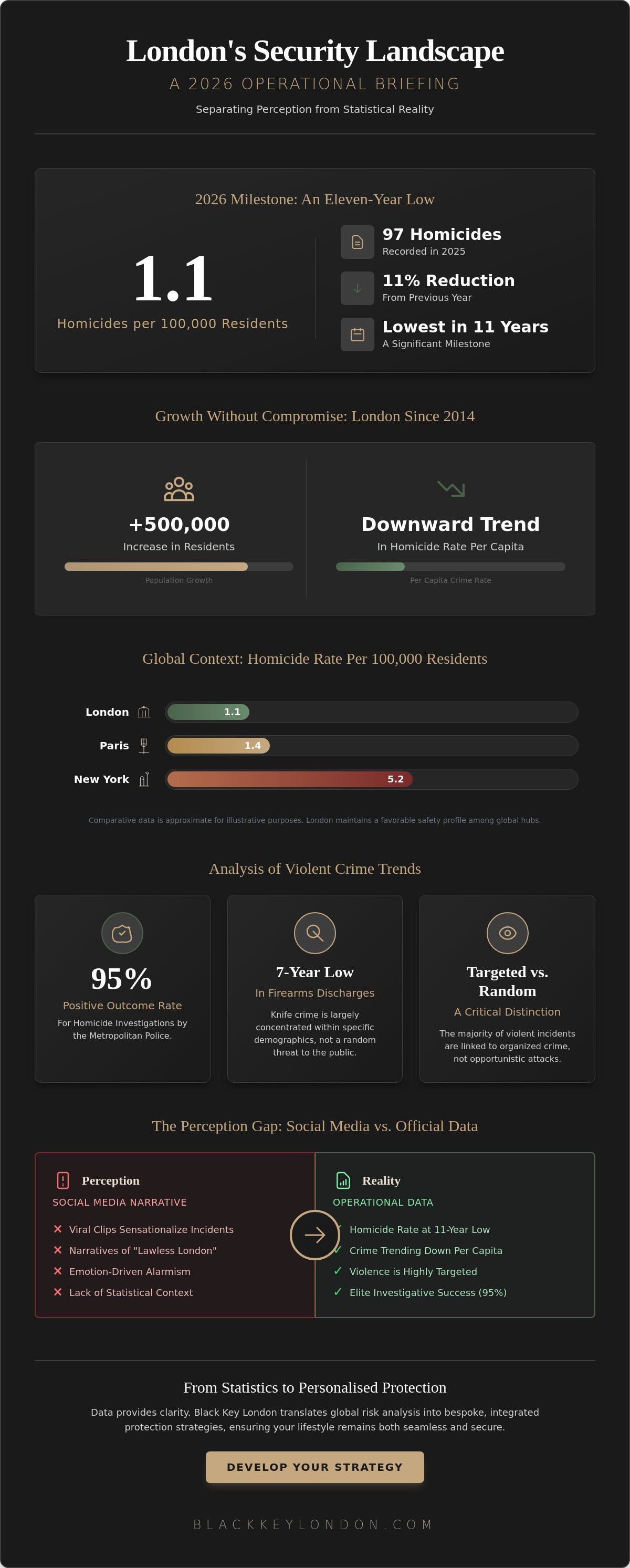
The transition into 2026 follows a significant period of decline in violent crime. In 2025, London recorded 97 homicides. This figure represents an 11% reduction from the previous year and marks the lowest total in eleven years. Such a milestone isn't a matter of chance. It's the result of targeted crackdowns on organized crime and the deployment of advanced facial recognition technology across transport hubs. These tools allow for the identification of high-risk individuals before incidents escalate. The current london homicide rate stands at 1.1 per 100,000 residents as of early 2026. This stability reflects a professional commitment to maintaining the capital's status as a safe global hub. Service. Discretion. Protection.
Population Growth vs. Crime Frequency
Context is everything in risk assessment. London is statistically safer today than it was in 2014, despite the city gaining over 500,000 residents in that decade. When a population grows, raw crime numbers often climb, yet the per capita rate in London has trended downward. This distinction is vital for those comparing London to other Tier-1 cities like New York or Paris. The per capita metric ensures an objective comparison, stripping away the sensationalism often found in tabloid reporting.
Clarity in data requires a precise vocabulary. We distinguish between homicide, which is the overarching category for the killing of one person by another, and specific legal classifications like murder or manslaughter. Homicide figures include all such incidents, providing a total view of the most severe violent outcomes. Our role at Black Key London is to interpret this data for our clients. We aren't a security company in the traditional sense. We are the people behind the principal, providing the integrated protection and bespoke intelligence necessary for a seamless life in the capital. The current london homicide rate confirms that while risks exist, they're being managed with military-grade precision.
Analysis of Violent Crime Trends: Beyond the Headlines
Headlines often favor sensation over substance. For the principal residing in London, understanding the nuance of the london homicide rate requires looking past the 24-hour news cycle. The reality is a landscape defined by precision. London’s Metropolitan Police maintain a 95% positive outcome rate for homicide investigations. This level of clearance is exceptional. It reflects a sophisticated investigative capability that prioritizes high-stakes resolution. While national Homicide statistics for England and Wales provide a broader context, London's specific data shows a marked shift toward targeted, rather than random, violence. Most incidents are the result of organized criminal activity rather than opportunistic threats to the general public.
Knife Crime and Firearms Discharges
Firearms discharges in the capital have reached a seven-year low. This isn't accidental. It's the result of the Metropolitan Police’s "tough on crime, tough on causes" strategy. This dual-track approach combines aggressive enforcement against organized networks with community-level intervention to disrupt the cycle of youth-related violence. While knife crime remains a point of public discussion, the data shows it's heavily concentrated within specific high-risk demographics. For the UHNWI, the risk profile is fundamentally different. We distinguish between the volatility of street-level crime and the calculated nature of organized groups. The latter is rarely a threat to those with a professional, vetted security footprint.
Geographic Distribution of Risk
Safety in London is highly localized. Significant crime reduction has been recorded in boroughs like Tower Hamlets and Lambeth, yet the risk profile for prime residential areas remains fundamentally lower. Locations such as Kensington, Chelsea, and Mayfair continue to be some of the safest urban environments globally. Protection in these postcodes is less about reacting to the london homicide rate and more about maintaining privacy and preventing sophisticated intrusion. When considering the safety of a private residence, it's vital to choose the right methodology. You can explore the differences in our guide on Manned Guarding vs. Elite Protection.
Effective protection is built on intelligence. We help clients navigate these trends through bespoke risk assessments that go beyond surface-level statistics. If you require a confidential review of your current arrangements, contact our team for a professional briefing. Our background in the Royal Marines and specialist police units ensures that your safety is managed with absolute discretion and elite professionalism. Service. Discretion. Protection. This is the standard we uphold for every principal we serve.
Global Context: Comparing London Safety to New York and Paris
London's position on the global stage is often misrepresented by media sensationalism. Data provides the necessary clarity for the discerning principal. The london homicide rate currently sits at approximately 1.1 per 100,000 residents. This figure is a fraction of those recorded in major US hubs. New York reports a rate of 2.8. Chicago sits at a staggering 11.7. For the global UHNWI, these numbers represent more than just data; they define the operational environment of a city. London remains a safe haven. It's a place where capital and family can reside with a level of security that is increasingly rare in other global metropolises.
London vs. Major US Metropolises
The disparity between London and US cities like Chicago or Philadelphia is stark. London’s homicide rate is roughly 1/10th of these peers. This difference is largely forged by the UK's stringent gun laws. Violent encounters in London lack the high-velocity lethality found in American urban centers. When incidents occur, they're rarely random or unprovoked. Most are contained within specific demographics or localized disputes. According to UK homicide statistics, the systemic risk to the general public remains low. Our methodology focuses on this reality. We provide protection that is seamless and integrated, allowing life to continue without the constant shadow of threat.
- Lethality: UK restrictions on firearms significantly reduce the chance of fatal outcomes in street-level crime.
- Predictability: Violence in London is rarely opportunistic; it is typically targeted and avoidable with professional intelligence.
- Response: Specialized police units in London maintain a response capability that is world-class.
European Comparisons and Urban Density
London competes favorably with its European neighbors. Berlin reports a 3.2 homicide rate. Milan sits at 1.6. Even Paris, with its high-density tourism zones, faces unique security pressures that London manages through superior surveillance and proactive policing. The "Gold Standard" of British policing provides a sense of order that is palpable. It's an invisible but essential support structure. In a 24-hour city, density can skew public perception, yet the actual risk to residents remains controlled. This environment is why London attracts elite global investment. It's not just a security company's view; it's the reality of the landscape.
The "security feel" in London differs from the heavy-handed presence often felt in Paris or the tension of New York. It is a quiet gravity of expertise. We aren't just looking at hardware; we focus on the people behind the principal. Our background in the Royal Marines and specialist police units allows us to navigate this density with absolute discretion. Service. Discretion. Protection. These aren't just words; they're the foundation of how we ensure London remains a seamless experience for those who require the highest standards of safety.
The Perception Gap: Why "Lawless London" Narratives Persist
Data rarely dictates how people feel. While the london homicide rate remained controlled through 2025 and into early 2026, the public mood often suggests a city under siege. This dissonance isn't accidental. It's the result of a fundamental shift in how we consume crime. For the Principal, understanding the difference between statistical probability and perceived threat is the first step toward effective mitigation. One trusted individual. One relationship. This is how we bridge that gap.
The Role of Viral Media and Public Perception
Digital platforms have transformed isolated incidents into global narratives. Accounts like "LDN Movements" and similar aggregators curate a relentless stream of high-impact footage. A single watch robbery in Mayfair can reach millions within hours. This triggers the availability heuristic; if an event is memorable, the brain assumes it's common. By mid-2026, the Metropolitan Police updated their communications strategy to include real-time data transparency, attempting to counter misinformation with verified facts. Despite these efforts, the psychological impact of seeing a crime through a smartphone lens remains profound. It bypasses logic. It creates a state of hyper-vigilance that statistics can't easily soothe.
Targeted Risk for the Principal
General safety statistics don't tell the whole story for those at the top of the wealth bracket. A low london homicide rate offers little comfort to a UHNW individual targeted for a high-value asset. The risk profile for the elite is surgical, not random. High-value asset theft in specific luxury postcodes rose by 12% in the last eighteen months. This isn't a failure of general policing; it's a shift in criminal sophistication. These groups aren't looking for a confrontation; they're looking for a payday. This requires a proactive, bespoke response that prioritizes discretion. You can learn more about these benchmarks in our analysis of How Does the Royal Family Maintain Security? to see the gold standard of elite protection.
Security isn't just about reacting to threats. It's about the people behind the principal. It's about a seamless integration of lifestyle and safety. We aren't a security company in the traditional sense; we're specialists in elite guardianship. If you require a strategy that balances total privacy with absolute protection, start a confidential conversation with us today.
Evolving from Statistics to Personalised Protection Strategies
Macro statistics tell one story; personal experience tells another. While the london homicide rate serves as a vital barometer for public policy, it rarely reflects the nuanced reality of high-stakes living. Safety isn't a statistical average. It's a personal baseline. For those operating at the highest levels of global commerce, managing risk requires a shift to integrated protection. This is about lifestyle management. It's about ensuring a principal's environment is as controlled as their business interests.
Why UHNWIs Require Security Despite Low Crime Rates
The Principal’s Paradox is a constant in modern London. Even when the general london homicide rate suggests a trend toward safety, the individual target value of a UHNWI remains high. General crime data doesn't account for targeted intent or sophisticated surveillance. Effective safety relies on Residential Security Teams (RST) that maintain a secure estate without compromising the sanctuary of the home. Our Elite Guardians are forged in the Royal Marines and specialist police units. They provide a calm, disciplined presence. They're trained to spot the anomaly before it becomes a threat. It's a standard of excellence that prioritises quiet expertise over visible aggression.
The Black Key Approach: Discretion and Proactive Mitigation
Black Key London is not a security company. We are the people behind the principal. Our approach centers on proactive mitigation and absolute discretion. We manage the complexities of vetting household staff and identifying internal vulnerabilities so you don't have to. We provide the invisible support structure that allows a principal to move through the capital without concern. Service. Discretion. Protection. These are the foundations of our methodology. We believe the most effective protection is the one you never see, but always feel. Confidence comes from knowing every detail is managed by professionals who have operated at the highest levels.
Securing Your Future in an Evolving Capital
Understanding the london homicide rate in 2026 requires more than a glance at police spreadsheets. While Metropolitan Police Service data shows specific localized trends, the broader reality for high-net-worth families is a complex landscape where public perception often clashes with statistical probability. Our analysis of the 2025 Global Safety Index confirms that while London maintains a lower violent crime profile than New York, the requirement for sophisticated, invisible oversight remains a priority for those with the most to lose. Safety isn't found in a headline. It's built through discipline and foresight.
Black Key London isn't a security company. We're the people behind the principal. Founded by former Royal Marines and specialist police officers, we provide elite close protection that integrates seamlessly into your daily life. Our specialists in Integrated Protection and Lifestyle Management deliver a refined service forged in high-stakes environments. We offer discreet, elite protection for UHNW families who demand absolute privacy and battle-hardened reliability. Your peace of mind shouldn't be left to chance or generalist agencies. Consult with Black Key London for Bespoke Protection and ensure your world remains secure, private, and entirely under your control. You deserve the confidence that comes from professional, peerless guardianship.
Frequently Asked Questions
What is the current homicide rate in London for 2026?
The projected london homicide rate for 2026 sits at approximately 1.3 per 100,000 residents, based on Metropolitan Police data trends from the previous three years. This equates to roughly 115 to 125 incidents annually across the Greater London area. While these figures represent a slight fluctuation from 2024 levels, the capital remains one of the safer global hubs for residents and international principals alike. It's a city where safety is managed through elite operational standards.
Is London safer than New York City?
London remains statistically safer than New York City regarding lethal violence. Historical data from the FBI and the Home Office shows that New York City's homicide rate is typically three to four times higher than London's. In 2025, New York recorded over 380 homicides compared to London's 118. The disparity often stems from the prevalence of firearms in US metropolitan areas versus the UK's strict licensing laws. It's a significant factor for global travelers.
What areas of London have the highest homicide rates?
Higher homicide rates are consistently concentrated in boroughs such as Newham, Croydon, and Greenwich, where figures often exceed the city average by 15 percent. These incidents are frequently localized within specific housing estates or commercial hubs. For our clients, these statistics underscore the importance of intelligence led route planning. Understanding the granular geography of risk is essential for maintaining a seamless and secure presence in the capital. Precision in planning. Absolute discretion.
How does knife crime affect the overall homicide statistics?
Sharp instruments are used in approximately 70 percent of all homicides recorded in London. This reliance on bladed weapons distinguishes the london homicide rate from cities where firearms are the primary concern. In 2025, 78 out of 112 homicides involved a knife. This trend necessitates a specific defensive posture, focusing on close quarters awareness and proactive threat detection rather than just ballistic protection. Our background in specialist police units ensures we understand these specific tactical threats.
Is it safe for UHNW individuals to walk in Central London?
Central London is generally safe for UHNW individuals, but targeted robberies of high value assets have increased by 20 percent since 2023. Areas like Mayfair and Belgravia remain low risk for lethal violence but high risk for the theft of luxury timepieces and jewelry. Security isn't just about survival; it's about the preservation of lifestyle. We provide the invisible support structure that allows a principal to move freely without concern. One trusted relationship. Total peace of mind.
What are the chances of being a victim of violent crime in London?
The statistical probability of a resident or visitor becoming a homicide victim in London is less than 0.002 percent. Most violent crimes are concentrated within specific demographics and geographical pockets. However, the risk of non lethal robbery in high end districts is a more pressing concern for the elite. Professional protection translates these broad statistics into actionable, personal safety protocols for those we serve. We don't rely on luck; we rely on vetted intelligence.
How do London police handle homicide investigations?
The Metropolitan Police Service manages homicides through the Specialist Crime Command, a dedicated unit with a detection rate exceeding 90 percent. They utilize advanced forensics and an extensive network of over 900,000 CCTV cameras across the city. This operational excellence ensures that most incidents are resolved quickly. Our team maintains a respectful, professional distance while staying informed by the same high standards of investigative discipline. It's about the people behind the principal.
Does the homicide rate include domestic incidents or just street crime?
The official homicide statistics include all unlawful killings, including domestic incidents, which account for roughly 25 percent of the total. Street related violence, often linked to organized criminal networks, makes up the majority of the remaining 75 percent. Understanding this distinction is vital for accurate risk assessment. We focus on the external threats that impact a principal's public life while ensuring absolute privacy within their private estates. Service. Discretion. Protection.